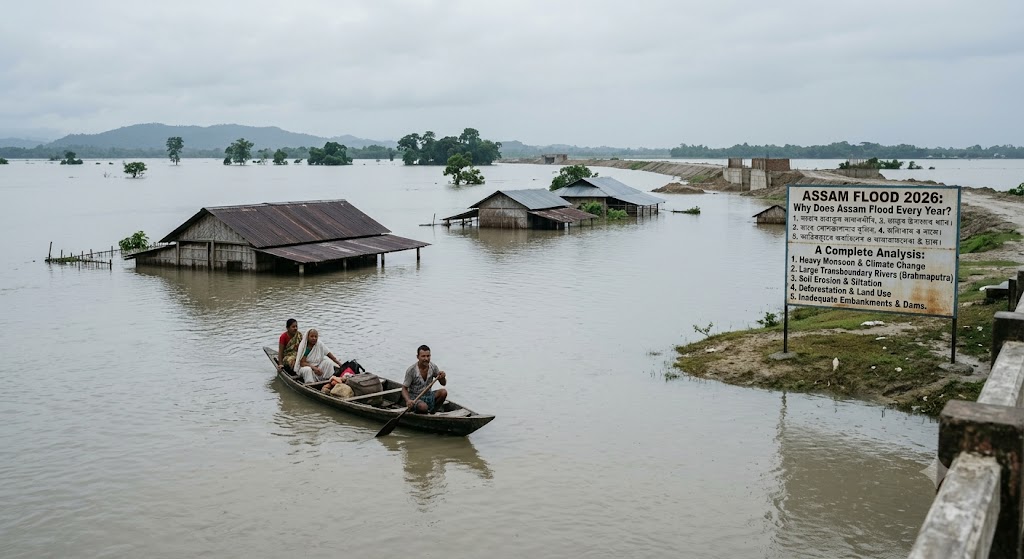
Assam Flood 2026: Why Does Assam Flood Every Year? Complete
Assam Flood 2026: Why Does Assam Flood Every Year? The Complete Story Behind India's Biggest Monsoon Disaster
Every year, when the monsoon arrives in India, one state appears in the headlines for the same heartbreaking reason—Assam floods.
Thousands of families leave their homes, roads disappear under water, crops are destroyed, wildlife struggles to survive, and rescue teams work around the clock. While floods affect many Indian states, Assam experiences one of the most severe and recurring flood disasters in South Asia.
The question is obvious:
Why does Assam flood almost every year?
Is it simply because of heavy rainfall, or are there deeper geographical and environmental reasons?
In this detailed article, we explain the science, geography, environmental factors, climate change, human activities, and long-term solutions behind Assam's annual floods.
Overview of Assam Flood 2026
The 2026 monsoon season has once again brought severe flooding across Assam. Continuous rainfall across Northeast India, combined with rising water levels in the Brahmaputra River and its tributaries, has submerged hundreds of villages and affected millions of people.
Transportation has been disrupted, agricultural land remains underwater, and several districts are battling floodwaters while rescue agencies continue evacuation operations.
Although floods occur every year, the intensity often varies depending on rainfall patterns and river discharge.
Why Does Assam Flood Every Year?
Unlike many states where floods occur only after extreme rainfall, Assam's geography naturally makes it one of the world's most flood-prone regions.
Several interconnected factors are responsible.
1. The Mighty Brahmaputra River – The Main Reason
The Brahmaputra River is one of the largest rivers in the world.
It begins in the glaciers of Tibet (where it is called the Yarlung Tsangpo), enters India through Arunachal Pradesh, flows across the entire Assam Valley, and finally enters Bangladesh.
The river carries an enormous volume of water every day.
During the monsoon, rainfall in Tibet, Arunachal Pradesh, Bhutan, Meghalaya, and Assam all contribute water to the Brahmaputra at nearly the same time.
As a result, the river swells dramatically and often crosses the danger mark.
Unlike many rivers, the Brahmaputra has an extremely wide channel with powerful currents that constantly change its course.
2. Heavy Monsoon Rainfall
Assam receives one of the highest annual rainfalls in India.
During June, July, August, and September, the southwest monsoon brings intense rainfall.
Some regions receive more than 2,000–3,000 mm of rainfall annually.
When several days of continuous rainfall occur, rivers, streams, and wetlands quickly overflow.
Since the ground becomes saturated, it cannot absorb additional water, leading to widespread flooding.
3. Water from the Himalayas
One of the biggest reasons behind Assam's floods is that the state receives water not only from its own rainfall but also from surrounding mountainous regions.
Heavy rainfall in:
- Arunachal Pradesh
- Bhutan
- Meghalaya
- Nagaland
flows rapidly downhill into Assam.
This causes a sudden increase in river discharge even if rainfall inside Assam itself is relatively moderate.
4. More Than 50 Tributaries Feed the Brahmaputra
The Brahmaputra is not a single river.
It is fed by dozens of tributaries, including:
- Subansiri
- Manas
- Jia Bharali
- Dhansiri
- Kopili
- Beki
- Puthimari
During the monsoon, these rivers also flood simultaneously.
Their combined flow dramatically increases the Brahmaputra's water level.
5. Sedimentation: The River Is Slowly Rising
This is one of the least understood but most important reasons.
The Brahmaputra carries one of the highest sediment loads in the world.
Every year it transports millions of tonnes of:
- sand
- silt
- gravel
- rocks
These sediments settle on the riverbed.
As the riverbed rises, the depth of the river decreases.
A shallower river cannot hold as much water.
Even moderate increases in discharge can therefore cause the river to overflow.
6. River Bank Erosion
The Brahmaputra is famous for changing its course.
Its fast-flowing water continuously erodes riverbanks.
Entire villages disappear into the river every year.
Thousands of hectares of fertile farmland are permanently lost.
Many families are forced to relocate repeatedly because their land literally disappears.
7. Assam Is a Natural Floodplain
Millions of years ago, the Brahmaputra created a vast floodplain.
Floodplains are naturally designed to spread excess water during heavy rainfall.
Much of modern Assam has been built on these floodplains.
Therefore, seasonal flooding is actually part of the river's natural behaviour.
The problem arises because millions of people now live in these areas.
8. Climate Change Is Making Floods Worse
Scientists believe climate change is increasing the frequency of extreme rainfall events.
Instead of receiving rainfall evenly across the season, Assam now experiences short periods of extremely intense rainfall.
Warmer temperatures also increase atmospheric moisture.
This means storms produce heavier rainfall than before.
Climate change is therefore amplifying flood intensity.
9. Deforestation in the Himalayas
Forests naturally slow down rainwater.
When forests are cleared,
- water flows faster,
- soil erosion increases,
- rivers carry more sediment.
This not only increases flooding but also raises riverbeds through sediment deposition.
10. Urbanisation and Poor Drainage
Rapid urban growth has reduced natural wetlands.
Concrete roads and buildings prevent rainwater from soaking into the ground.
As a result, cities experience flash floods much faster than before.
Poor drainage systems worsen the situation.
Districts Frequently Affected
Some of Assam's most flood-prone districts include:
- Dhemaji
- Lakhimpur
- Darrang
- Morigaon
- Nagaon
- Golaghat
- Barpeta
- Dhubri
- Cachar
- Jorhat
These districts experience repeated flooding almost every monsoon season.
Impact on Agriculture
Agriculture is one of Assam's primary sources of livelihood.
Floods destroy:
- paddy fields
- vegetable farms
- tea plantations in some regions
- fisheries
- livestock
Many farmers lose an entire year's income within a few days.
Impact on Wildlife
Flooding severely affects Kaziranga National Park, home to the famous one-horned rhinoceros.
Although seasonal floods are a natural ecological process, extreme floods force animals to migrate to higher ground.
Many animals are injured or killed while crossing highways.
Economic Losses
Floods cause enormous financial damage through:
- destroyed infrastructure
- damaged roads
- collapsed bridges
- crop losses
- business disruption
- school closures
- healthcare emergencies
Every year, recovery costs run into thousands of crores of rupees.
Government Response
During major floods, multiple agencies work together:
- Assam State Government
- National Disaster Response Force (NDRF)
- State Disaster Response Force (SDRF)
- Indian Army
- Indian Air Force
- Local volunteers
Relief camps provide food, drinking water, medicines, and temporary shelter.
Can Assam Floods Be Prevented?
Experts believe floods cannot be completely eliminated because they are a natural part of the Brahmaputra ecosystem.
However, their impact can be significantly reduced through:
Better River Management
Regular dredging where appropriate, improved sediment management, and scientific river studies.
Stronger Embankments
Modern flood-resistant embankments require continuous maintenance.
Early Warning Systems
Satellite monitoring and AI-based flood forecasting can help communities evacuate earlier.
Wetland Conservation
Wetlands naturally absorb excess water and reduce flooding.
Afforestation
Planting forests in upstream catchments reduces erosion and slows runoff.
Climate Adaptation
Building elevated homes, flood-resilient infrastructure, and climate-smart agriculture can reduce long-term losses.
Conclusion
Assam's floods are not caused by a single factor. They result from a complex combination of geography, the mighty Brahmaputra River, Himalayan rainfall, sediment deposition, climate change, deforestation, and increasing human settlement on natural floodplains.
While floods may never disappear completely, scientific river management, stronger infrastructure, better forecasting, environmental conservation, and climate adaptation can significantly reduce their devastating impact.
Understanding why Assam floods every year is the first step toward building a safer and more resilient future for millions of people living in India's flood-prone Northeast.
Related Articles

Constitution (131st Amendment) Bill 2026 Explained: Why Women’s Reservation Bill Failed in Lok Sabha
READ MORE →
8th Pay Commission Update: Deadline बढ़ी, Basic Pay और Pension Demand की पूरी जानकारी
READ MORE →