China की खेती में बड़ा बदलाव! NASA Images ने दिखाई 820+ Sq
China’s Farmland Has Changed Dramatically: NASA Images Show a Massive Greenhouse Transformation
Satellite images released through NASA Earth Observatory have revealed a remarkable transformation in the agricultural landscape around Weifang in eastern China.
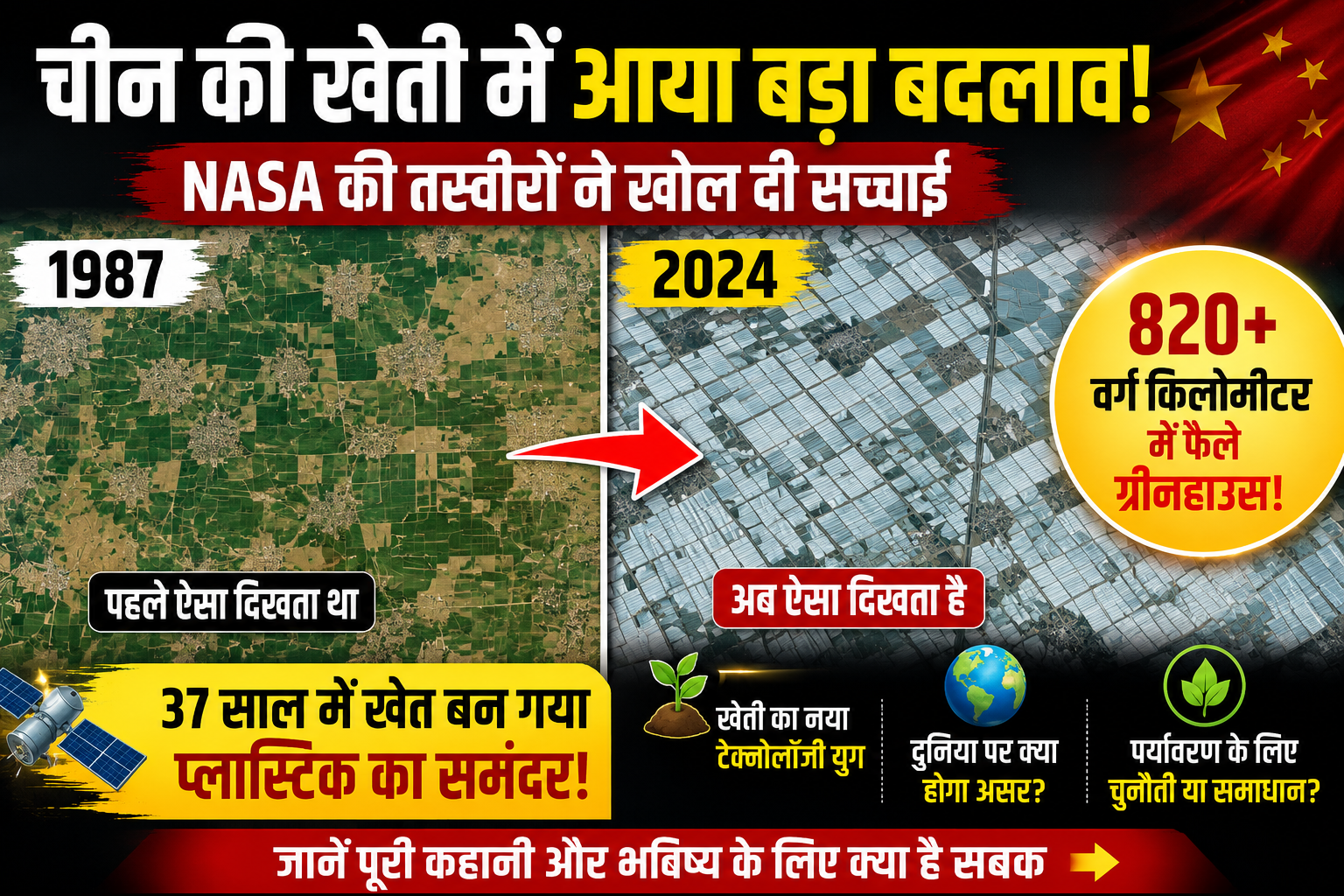
What once appeared largely as open farmland in satellite imagery from 1987 has, decades later, become one of the world's largest concentrations of agricultural greenhouses.
According to a report by The Times of India, comparisons of Landsat satellite images from May 7, 1987, and May 20, 2024, show how extensive greenhouse cultivation has become in the region. The greenhouse-covered area around Weifang now extends across more than 820 square kilometres. (The Times of India)
The transformation provides a striking example of how technology, agricultural demand and changing farming practices can reshape landscapes on a massive scale.
What Did NASA’s Satellite Images Show?
Satellite imagery provides a unique way to observe changes that are difficult to understand from the ground.
In the 1987 imagery, much of the area surrounding Weifang appeared as conventional agricultural land, with large stretches of cultivated fields across the North China Plain.
By 2024, the same landscape looked dramatically different.
Large numbers of greenhouses covered the agricultural area, producing a distinctive pattern of white and transparent structures visible from space.
The concentration is so extensive that the region can appear almost like a “sea of plastic” when viewed through satellite imagery. (The Times of India)
Where Is This Massive Greenhouse Cluster Located?
The transformation highlighted in the satellite comparison is centered around Weifang, a city in eastern China.
The region is part of the broader North China Plain, one of China's important agricultural areas.
Over the decades, greenhouse farming has expanded significantly in the region, allowing farmers to grow crops under controlled or semi-controlled conditions rather than relying entirely on open-field agriculture.
The scale of the development is particularly notable because the greenhouse landscape is visible across hundreds of square kilometres from space.
More Than 820 Square Kilometres of Greenhouses
One of the most striking figures associated with the transformation is the size of the greenhouse cluster.
The area around Weifang covered by greenhouses is reported to exceed 820 square kilometres.
That scale makes the development significant not just from an agricultural perspective but also from an environmental and geographical standpoint.
A landscape that once consisted predominantly of traditional fields has gradually evolved into a highly intensive agricultural production zone.
Why Are Greenhouses Becoming So Important?
Greenhouse agriculture gives farmers greater control over growing conditions.
Unlike conventional outdoor farming, protected cultivation can help farmers manage several factors, including:
-
Temperature
-
Humidity
-
Water availability
-
Crop growing conditions
-
Seasonal production
-
Protection from certain weather conditions
This can allow agricultural production to continue during periods when outdoor conditions may not be ideal.
For regions with large populations and strong demand for fresh produce, greenhouse farming can therefore become an attractive agricultural strategy.
China’s Growing Dominance in Greenhouse Agriculture
The transformation around Weifang is part of a much larger trend in China.
According to research cited by the report, greenhouse cultivation covered approximately 1.3 million hectares globally in 2019, with China accounting for around 60% of the global total. (The Times of India)
This highlights the enormous scale of China's protected agriculture sector.
China's rapid expansion in greenhouse farming has been particularly noticeable since around 2000, when greenhouse cultivation expanded more rapidly in several parts of the country. (The Times of India)
Why Did Greenhouse Farming Expand So Rapidly?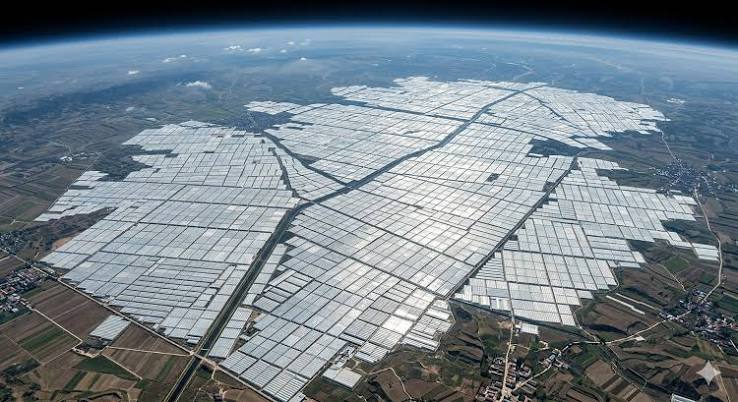
There is no single reason behind the expansion.
Several factors can contribute to the growth of protected agriculture.
1. Increasing Food Demand
China has a huge population and substantial demand for vegetables and other agricultural products.
Greenhouse farming can help farmers increase production and provide fresh produce more consistently throughout the year.
2. Better Control Over Growing Conditions
Greenhouses provide a degree of protection from weather conditions.
Farmers can create more controlled environments for crops, potentially improving production efficiency.
3. Expansion of Intensive Agriculture
As agricultural land becomes increasingly valuable, farmers may seek methods that allow them to generate greater production from available land.
Greenhouse agriculture can support intensive cultivation by allowing farmers to carefully manage growing conditions.
4. Agricultural Technology
Advances in irrigation, plastic materials, crop management and greenhouse construction have made protected cultivation increasingly practical.
Together, these developments have helped greenhouse farming expand across large agricultural regions.
Why Does the Landscape Look Different From Space?
One fascinating aspect of the story is how clearly the transformation can be observed using satellite imagery.
Traditional agricultural fields usually produce patterns associated with soil, crops and vegetation.
Greenhouse structures, however, reflect sunlight differently.
Large numbers of greenhouse roofs can therefore create bright, highly visible patterns in satellite images.
When thousands of structures are concentrated in one region, the result becomes visible across a very large area.
This makes satellite imagery particularly useful for studying long-term agricultural changes.
From Traditional Farmland to a “Sea of Plastic”
The phrase “sea of plastic” describes the visual effect created by the enormous concentration of greenhouse structures.
The term refers to the plastic-covered roofs that dominate the landscape when viewed from above.
The transformation is important because it demonstrates that agricultural development does not always mean expanding farmland horizontally.
Instead, modern agriculture can dramatically change the physical appearance and intensity of land already being cultivated.
What Does This Mean for the Environment?
The expansion of greenhouse farming can bring agricultural benefits, but it can also create environmental challenges.
Large-scale greenhouse agriculture requires materials such as plastic coverings, irrigation systems and other infrastructure.
The management of these materials becomes important as greenhouse structures age and are replaced.
There can also be concerns related to:
-
Plastic waste
-
Water consumption
-
Soil management
-
Energy use
-
Changes in land use
-
Agricultural runoff
The environmental impact depends heavily on how greenhouse farming is designed and managed.
The Importance of Satellite Monitoring
The Weifang example also demonstrates why satellite technology has become increasingly important for environmental and agricultural research.
Satellites can provide a historical record of how landscapes change over decades.
Instead of relying only on ground surveys, researchers can compare images taken years or even decades apart.
In this case, the comparison between 1987 and 2024 provides a visual record of nearly four decades of agricultural transformation. (The Times of India)
Satellite-based monitoring can help researchers understand:
-
Agricultural expansion
-
Land-use changes
-
Urban growth
-
Deforestation
-
Climate-related changes
-
Water resources
-
Changes in vegetation
Why Weifang’s Transformation Matters Globally
The scale of the greenhouse development around Weifang is more than just a local agricultural story.
It reflects a broader global trend toward intensive and technology-driven agriculture.
As populations grow and climate conditions become more challenging, countries are increasingly exploring ways to produce food more efficiently.
Protected agriculture is one possible solution because it can provide greater control over growing conditions.
However, its long-term sustainability depends on factors such as water management, energy consumption, waste management and the environmental impact of greenhouse materials.
A 37-Year Transformation
The satellite comparison effectively captures a transformation spanning almost four decades.
1987
The landscape around Weifang was dominated largely by conventional agricultural fields.
2000s
Greenhouse cultivation began expanding more rapidly in China, contributing to a major shift toward protected agriculture. (The Times of India)
2024
The landscape had changed dramatically, with extensive greenhouse structures covering more than 820 square kilometres around the Weifang region.
This timeline shows how quickly agricultural landscapes can change when technology and economic demand drive a new method of production.
Key Facts at a Glance
| Topic | Details |
|---|---|
| Location | Weifang, eastern China |
| Region | North China Plain |
| Satellite comparison | 1987 vs 2024 |
| 1987 image date | May 7, 1987 |
| 2024 image date | May 20, 2024 |
| Greenhouse area around Weifang | More than 820 sq km |
| Global greenhouse cultivation | About 1.3 million hectares in 2019 |
| China's share | Around 60% |
| Major expansion period | Particularly rapid after 2000 |
| Main technology | Protected/greenhouse agriculture |
What Can Other Countries Learn From China?
China's greenhouse expansion provides an important case study for countries looking to increase agricultural productivity.
Countries facing limited arable land, extreme weather or growing food demand may increasingly explore protected cultivation.
However, simply expanding greenhouse farming is not enough.
Future agricultural systems will also need to focus on:
Higher productivity + Efficient water use + Lower waste + Sustainable materials + Smart technology
Combining these factors could make intensive agriculture more sustainable.
Conclusion
NASA satellite imagery has provided a remarkable view of how China's agricultural landscape has changed over nearly four decades.
The area around Weifang has evolved from predominantly open farmland into one of the world's largest concentrations of greenhouse agriculture, with the greenhouse-covered region now extending across more than 820 square kilometres. (The Times of India)
The transformation highlights the growing role of technology in food production and demonstrates how dramatically human agricultural activity can reshape landscapes.
At the same time, the development raises important questions about the long-term sustainability of intensive farming, particularly regarding water, plastic waste, energy and land management.
For researchers, policymakers and farmers around the world, the Weifang transformation offers an important lesson: the future of agriculture may increasingly be shaped not only by the land we cultivate, but by the technology we use to cultivate it.