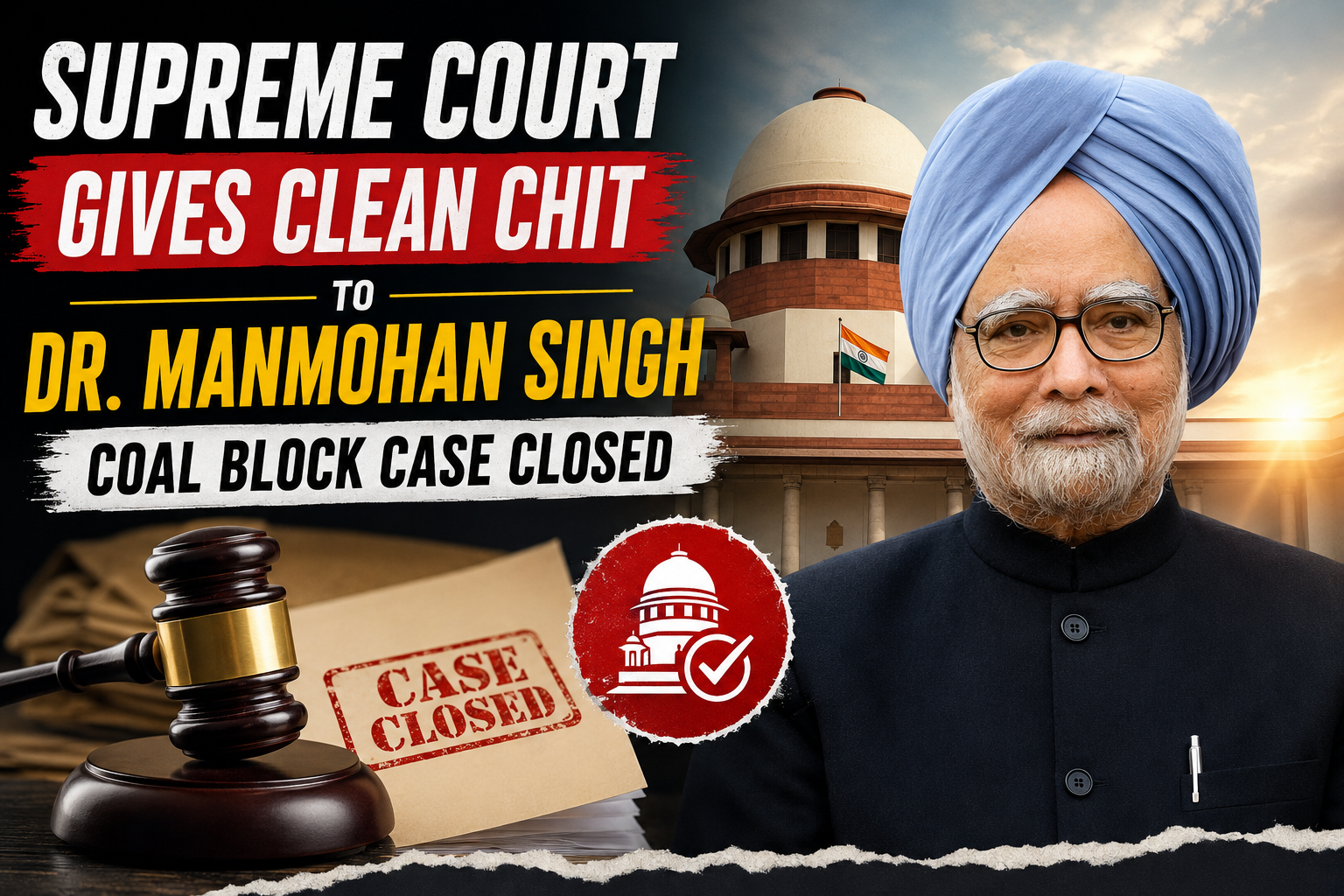
Coal Block Case Closed: Supreme Court Clears Dr. Manmohan
Supreme Court Gives Clean Chit to Late Former PM Dr. Manmohan Singh: Coal Block Allocation Case Finally Closed
Published on: July 31, 2026 Category: Legal Affairs / Indian Politics / Supreme Court
In a landmark judgment with major legal and political implications, the Supreme Court of India has completely closed the criminal proceedings against late former Prime Minister Dr. Manmohan Singh in the Talabira-II coal block allocation case. The Court set aside the 2015 special trial court order that had summoned him as an accused and accepted the CBI’s closure reports, concluding that no criminal offence was made out against him.
The verdict is being viewed as one of the most significant judicial developments in the long-running coal allocation cases, often referred to as part of the broader “Coalgate” controversy.
What Was the Case About?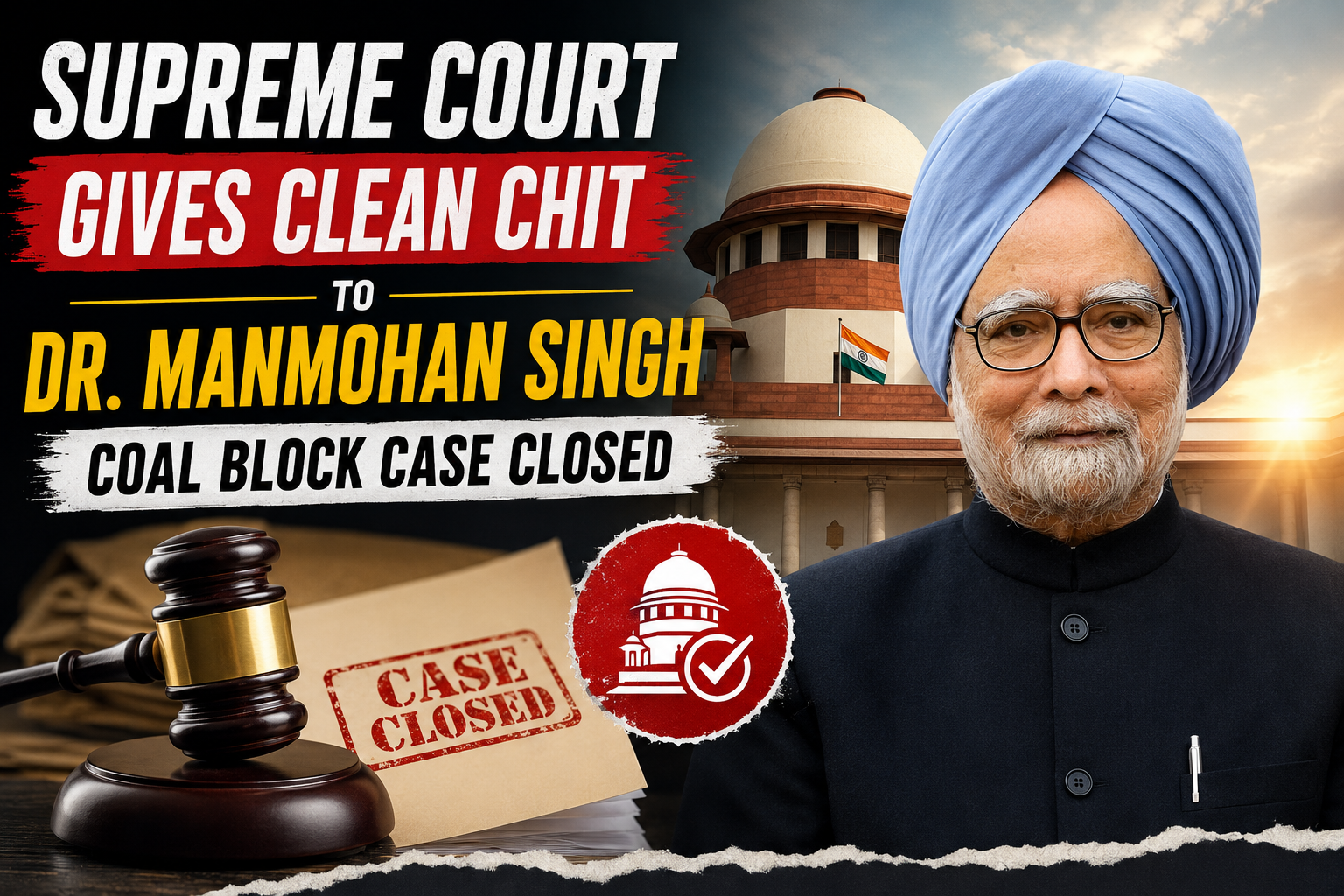
The case related to the allocation of the Talabira-II coal block in Odisha in 2005 to Hindalco Industries. At that time, Dr. Manmohan Singh was not only the Prime Minister but was also holding additional charge of the Ministry of Coal.
The allegation was that irregularities had occurred in the allocation process and that senior officials and decision-makers should face criminal scrutiny.
However, after investigation, the Central Bureau of Investigation (CBI) filed closure reports stating that there was no evidence of criminal conspiracy, corruption, or dishonest intention on the part of Dr. Manmohan Singh.
Supreme Court’s Final Verdict
A three-judge bench comprising Chief Justice Surya Kant, Justice Joymalya Bagchi, and Justice V. Mohana held that the special CBI court had erred in rejecting the CBI’s closure reports and summoning the former Prime Minister.
The Court observed that there were no cogent or compelling reasons for the trial judge to discard the findings of the investigating agency.
As a result, the Supreme Court:
-
Quashed the 2015 summoning order against Dr. Manmohan Singh.
-
Accepted the CBI closure reports.
-
Expunged the adverse observations made by the special trial court.
-
Closed the criminal proceedings on merits, not merely on technical grounds.
Case at a Glance
Coal block
Talabira-II, Odisha
Allocation year
2005
Special court order
11 March 2015
Supreme Court stay
1 April 2015
Final Supreme Court judgment
29 July 2026
Outcome
Clean chit to Dr. Manmohan Singh
How the Case Reached the Supreme Court
The controversy intensified after the Comptroller and Auditor General (CAG) raised concerns about coal block allocations across several cases. Following public and political pressure, the CBI registered multiple FIRs related to coal allocations.
In the Talabira-II matter, however, the CBI’s investigation did not find evidence sufficient to prosecute Dr. Manmohan Singh.
Despite this, Special CBI Judge Bharat Parashar, on 11 March 2015, rejected the closure reports and summoned:
-
Dr. Manmohan Singh
-
Kumar Mangalam Birla
-
Former Coal Secretary P.C. Parakh
-
Hindalco Industries
Dr. Singh challenged the order before the Supreme Court, which stayed the summons on 1 April 2015.
Timeline of Major Events
| Year | Development |
|---|---|
| 2005 | Talabira-II coal block allocated to Hindalco Industries. |
| 2012–2014 | CAG report leads to wider scrutiny of coal allocations; CBI begins investigations. |
| 2014 | CBI files closure reports exonerating Dr. Manmohan Singh. |
| March 2015 | Special CBI court rejects closure reports and summons Dr. Singh. |
| April 2015 | Supreme Court stays the summons. |
| December 2024 | Dr. Manmohan Singh passes away. |
| July 2026 | Supreme Court quashes the trial court order and closes the case on merits. |
Why the Court Heard the Case Even After Dr. Singh’s Death
Normally, criminal appeals may become infructuous after the death of the accused. Senior Advocates Kapil Sibal and Abhishek Manu Singhvi, appearing for Dr. Manmohan Singh, argued that the Court should still examine the matter because the trial court had made serious adverse observations against a former Prime Minister.
The Supreme Court agreed that the issue involved not just procedural closure but also the official and public record of a constitutional functionary.
The bench therefore examined the CBI closure reports and the trial court’s reasoning in detail before delivering its final judgment.
What Did the Supreme Court Say?
The Court stated that it had carefully gone through both closure reports filed by the CBI and found no justification for the special judge to reject them.
The bench observed in substance that the trial court had failed to provide adequate legal reasons for taking cognizance against Dr. Manmohan Singh after the investigating agency had found no prosecutable case.
This is important because the Supreme Court did not merely close the appeal due to abatement; it specifically addressed the merits of the controversy.
Key Legal Principles Emerging from the Judgment
1. Trial Courts Cannot Reject Closure Reports Arbitrarily
The judgment reinforces that when an investigating agency submits a detailed closure report after investigation, the trial court must provide strong, cogent, and legally sustainable reasons if it chooses to reject that report.
2. Administrative Decisions Are Not Automatically Criminal
The Court’s reasoning supports the principle that policy or administrative decisions taken in official capacity do not become criminal offences unless accompanied by evidence of corruption, conspiracy, dishonest intention, or personal gain.
3. Protection of Institutional Fairness
By examining the case on merits, the Court emphasized the need to maintain fairness when serious allegations are made against holders of high constitutional office.
Political Significance of the Verdict
Dr. Manmohan Singh served as India’s Prime Minister from 2004 to 2014 and was widely regarded for his integrity and technocratic style of governance.
The coal allocation controversy had cast a shadow over the later years of the UPA government. The Supreme Court’s decision is therefore likely to influence how historians and political analysts assess Dr. Singh’s role in the controversy.
Supporters of the former Prime Minister have described the verdict as a judicial restoration of his reputation, while legal observers have focused on its implications for criminal procedure and the treatment of closure reports.
Difference Between “Closure on Technical Grounds” and “Closure on Merits”
This distinction is crucial.
Technical closure (abatement)
The case ends because the accused has died; the court does not decide whether the allegations were true or false.
Closure on merits
The court examines the evidence and concludes that the prosecution was not legally justified.
The Supreme Court chose the second course, which is why the judgment is being interpreted as a complete exoneration rather than a procedural disposal.
Impact on Other Coal Allocation Cases
The ruling does not automatically affect all coal block allocation cases. Each case depends on its own evidence, charges, and procedural history.
However, the judgment may be cited in future cases involving:
-
Rejection of CBI closure reports
-
Summoning of public servants after investigation
-
Requirement of reasons while taking cognizance
-
Distinction between administrative error and criminal misconduct
Reactions Across the Legal Community
Many legal commentators have highlighted the judgment as a reaffirmation of judicial discipline in criminal procedure. The emphasis on reasoned orders and evidentiary standards is being seen as particularly significant.
Former judges and senior lawyers have also noted that the Court’s decision to expunge adverse observations reflects concern for the fairness of the judicial record.
Final Analysis
The Supreme Court’s July 2026 judgment brings an end to a case that had remained pending for more than eleven years after the special court’s summoning order.
For Dr. Manmohan Singh, who passed away in December 2024, the verdict amounts to a full judicial clean chit in the Talabira-II coal block allocation case.
For the legal system, the ruling reinforces three important principles:
-
Criminal prosecution must rest on evidence, not suspicion.
-
Closure reports cannot be rejected without strong legal reasoning.
-
Administrative decision-making and criminal liability are not the same thing.
More broadly, the judgment closes one of the most prominent remaining criminal proceedings connected to the coal allocation controversy and is likely to remain an important precedent in discussions on criminal accountability of high public officials and the limits of judicial cognizance after investigative closure.