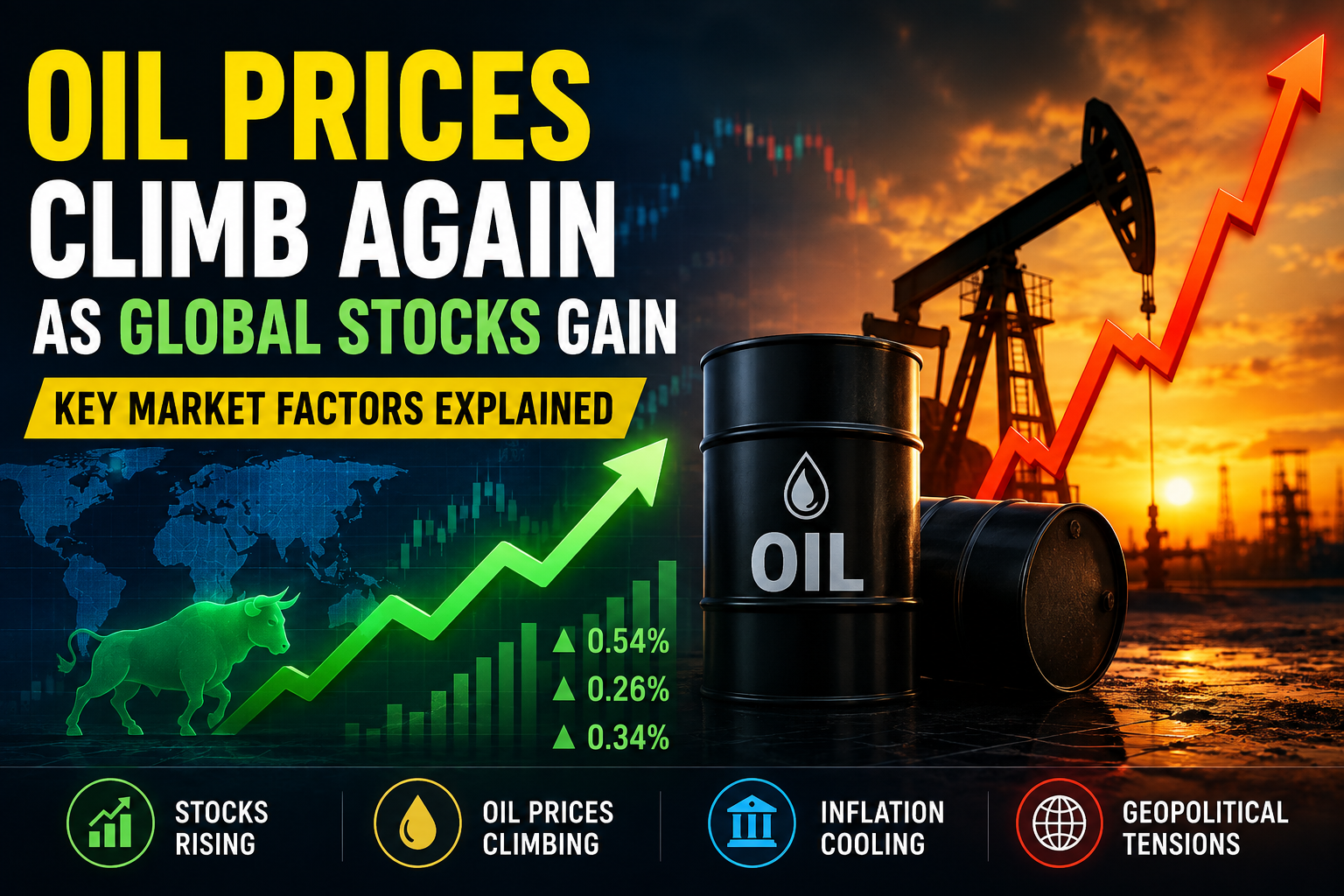
Oil Prices Climb as Global Stocks Rise: Key Market Factors
Oil Prices Climb as Global Stocks Advance: What Is Driving Markets?
Global financial markets have recently moved in two directions that usually do not rise together for long: crude oil prices have edged higher while major stock markets have also gained ground. The combination reflects a delicate balance between easing inflation pressures, expectations for stable interest rates, strong technology earnings, and persistent geopolitical uncertainty in the Middle East.
Investors are trying to answer a key question: Can equities continue to rally if energy prices remain elevated?
Market Snapshot
| Asset | Recent Trend |
|---|---|
| Brent Crude | Higher, near the upper-$80s per barrel |
| WTI Crude | Higher, in the low-$80s per barrel |
| MSCI World Index | Modest gains |
| S&P 500 | Positive |
| Nasdaq Composite | Outperforming on technology strength |
These moves show that investors are not treating the current environment as a classic “risk-off” episode. Instead, markets appear to be pricing in slower inflation without a sharp economic slowdown.
Why Stocks Are Rising

Cooling Inflation Is Helping
The most important support for equities has been the recent moderation in inflation data. When inflation comes in close to expectations, investors become less worried that central banks—especially the U.S. Federal Reserve—will need to resume aggressive interest-rate hikes.
Lower rate fears matter because they:
-
Reduce borrowing costs for companies
-
Increase the present value of future earnings
-
Improve sentiment toward growth sectors such as technology
Even a small downside surprise in inflation can have a noticeable effect on market psychology.
Technology and AI Remain the Leadership Group
Another major driver has been continued strength in cloud computing, artificial intelligence infrastructure, and semiconductor-related companies. Strong earnings from large technology firms have helped offset weakness in more cyclical sectors such as manufacturing and industrials.
This is one reason the Nasdaq has generally outperformed broader global indices.
Why Oil Prices Are Also Moving Higher

Geopolitical Risk Is Supporting Crude
Oil markets are receiving support from ongoing geopolitical tensions in the Middle East. Traders are paying close attention to developments that could affect shipping routes and energy supplies.
The Strait of Hormuz remains one of the world’s most important oil transit chokepoints. Any increase in security concerns can raise the risk premium embedded in crude prices, even if actual supply disruptions remain limited.
Demand Is Not Collapsing
At the same time, global oil demand forecasts have softened in some regions, but they have not fallen enough to create a large surplus. This has helped keep Brent crude relatively firm.
In other words, the market is balancing:
Softer demand expectations
A bearish force for oil prices.
Persistent geopolitical and supply risks
A bullish force for oil prices.
The Unusual Combination: Higher Oil and Higher Stocks
Historically, a sharp rise in oil prices can hurt equities because it increases costs for businesses and consumers. However, the current move in crude has been moderate rather than explosive.

Markets are effectively saying:
-
Oil is high, but not yet high enough to threaten growth seriously.
-
Inflation is easing, so central banks may stay patient.
-
Corporate earnings, especially in technology, remain resilient.
This creates a temporary window in which both asset classes can advance together.
What It Means for India and Other Oil-Importing Economies
For countries that import most of their energy, the picture is more complicated.
Pressure on Import Bills
Higher crude prices increase the cost of imported oil, which can widen the current account deficit and put pressure on the domestic currency.
Winners and Losers
| Potential Beneficiaries | Potential Pressure |
|---|---|
| Upstream oil producers | Airlines |
| Exploration companies | Paint manufacturers |
| Energy service firms | Logistics companies |
| Some commodity exporters | Chemical and packaging firms |
In India, companies linked to crude production may benefit from stronger realizations, while fuel-intensive industries could see margin pressure if elevated prices persist.
Could Higher Oil Reignite Inflation?
This is the biggest medium-term risk.

If crude remains above roughly $85–90 per barrel for an extended period, it can eventually feed into:
-
Transportation costs
-
Airfares
-
Manufacturing expenses
-
Food distribution costs
Central banks would then have to decide whether the energy-driven inflation is temporary or broad enough to require a policy response.
For now, most policymakers are watching core inflation—which excludes volatile food and energy components—more closely than headline inflation.
What Investors Should Watch Next
1. Federal Reserve Signals
Any indication that the Fed is becoming more concerned about energy-driven inflation could affect both bonds and equities.
2. OPEC+ Decisions
Production policy remains a key variable for the oil market. Supply adjustments can quickly change the balance between surplus and deficit.
3. Global Demand Data
Manufacturing activity in China, the United States, and Europe will provide clues about future fuel consumption.
4. Middle East Developments
Changes in diplomatic or security conditions that affect shipping confidence could alter the geopolitical premium in oil prices.
The Bottom Line
The recent rise in both oil prices and global stock markets reflects a market that is trying to price in slower inflation, stable interest rates, resilient technology earnings, and manageable—not catastrophic—geopolitical risk.
The current environment is supportive for risk assets, but it is also fragile. If oil prices climb much further or remain elevated for too long, the same factor that is currently being tolerated by investors could become a renewed source of inflation concern.
For now, the key takeaway is simple:
Cooling inflation + strong tech earnings
Moderately high oil + geopolitical uncertainty
Result: Stocks rise while crude stays supported
Whether this balance can hold through the next round of central-bank meetings and energy-market developments will likely determine the direction of global markets in the weeks ahead.