PM Modi’s 6 Big Announcements: AI Training, Free Coaching &
PM Modi’s 6 Big Independence Day Announcements 2026: AI Training, Free Coaching, Sports Talent Hunt and More
By SkillSiksha Editorial Team | Published: August 16, 2026
India celebrated its 80th Independence Day on August 15, 2026, with Prime Minister Narendra Modi addressing the nation from the ramparts of the Red Fort.
This year's address placed a strong focus on young Indians, artificial intelligence, education, sports, national security, semiconductor manufacturing and energy security. Alongside the larger vision of building a Viksit Bharat by 2047, the Prime Minister announced several initiatives that could directly affect students, young professionals and India's future workforce.
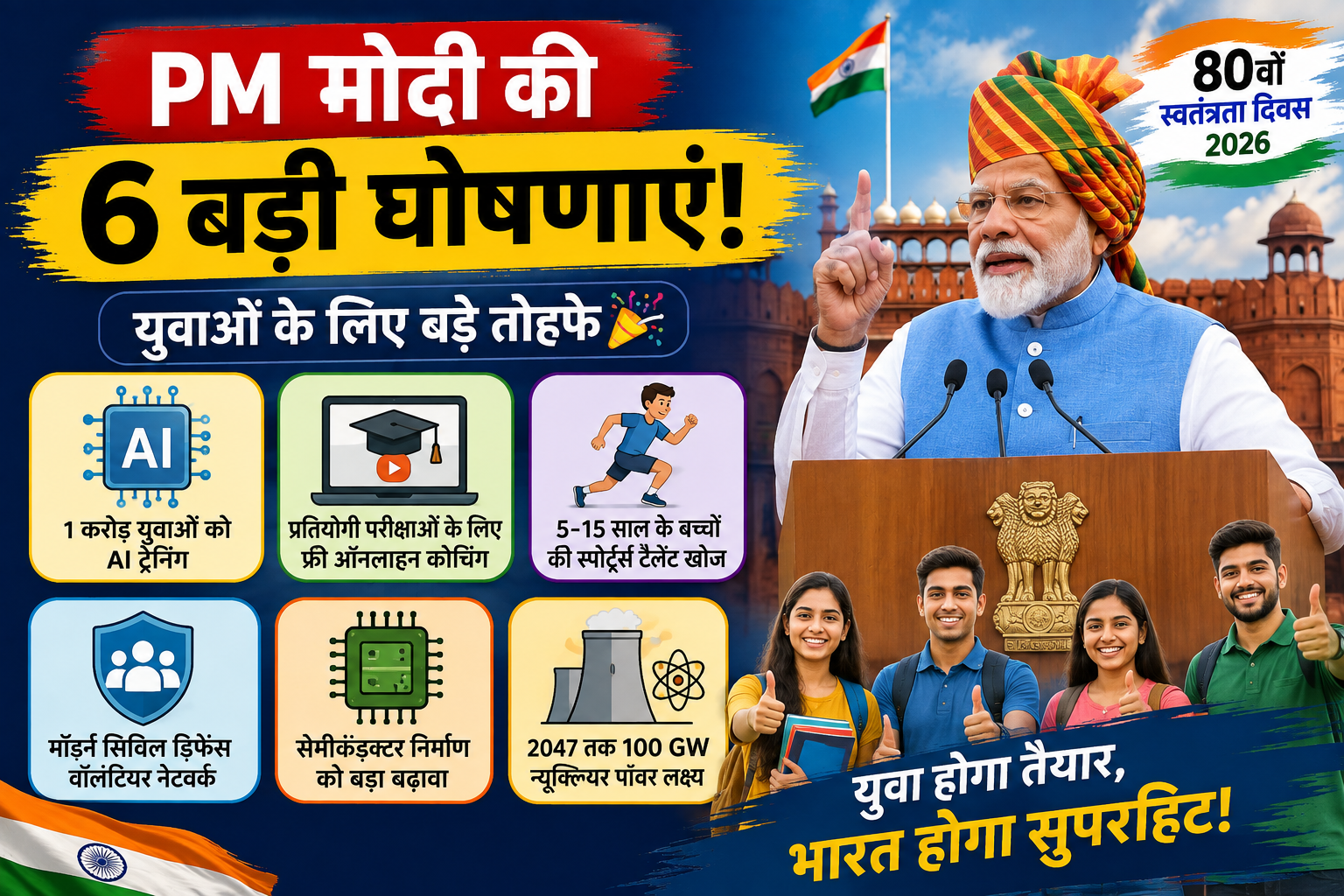
Among the most significant announcements were a plan to provide AI skill training to 1 crore youth within one year, a free online coaching network for competitive examinations, a nationwide sports talent hunt for children aged 5–15 years, a modern Civil Defence volunteer network, expansion of semiconductor manufacturing and a target of 100 GW nuclear power capacity by 2047. (Prime Minister of India)
Here is a detailed look at the six major announcements.
1. AI Skill Training for 1 Crore Youth
One of the biggest announcements of the Independence Day speech was the government's plan to provide AI skill training to 1 crore young Indians within the coming year.
The announcement reflects how rapidly Artificial Intelligence is changing education, employment, business and technology.
PM Modi said India wants its youth to develop the capabilities needed to lead globally in AI. (Prime Minister of India)
Why Is This Important?
AI is increasingly being used across sectors such as:
-
Software and IT
-
Finance
-
Healthcare
-
Manufacturing
-
Education
-
Agriculture
-
Defence
-
Media
-
Transportation
The demand is also moving beyond traditional computer science roles. Professionals in fields such as civil engineering, mechanical engineering, commerce, marketing and management are increasingly expected to understand AI-enabled tools.
Therefore, large-scale AI skilling could potentially help students and young workers acquire skills relevant to the changing job market.
India's Existing AI-Skilling Ecosystem
The new announcement comes on top of existing government AI initiatives.
For example, YUVA AI for ALL, launched under the IndiaAI Mission, provides a free foundational AI course. Government data reported 85.27 lakh enrolments as of July 8, 2026. (Press Information Bureau)
This existing ecosystem could provide a foundation for expanding AI education to a much larger population.
What Could the Programme Mean for Students?
If implemented at scale, AI training could help young people understand:
-
Generative AI
-
AI productivity tools
-
Data analysis
-
Machine learning fundamentals
-
Responsible AI use
-
AI-assisted problem solving
-
Emerging technology careers
However, the exact structure, eligibility criteria, certification mechanism and training partners for the newly announced 1-crore programme will be important to watch as the government releases further implementation details.
2. Free Online Coaching for Competitive Examinations
For students preparing for government jobs and other competitive examinations, the announcement of a nationwide free online coaching network could be particularly significant.
PM Modi highlighted the financial burden that coaching can place on families and announced that the government would bring together Digital Public Infrastructure, teachers and educational resources to create a network for free online coaching. (Prime Minister of India)
Why Is Free Coaching Significant?
Competitive-exam preparation can involve considerable expenses, including:
-
Coaching fees
-
Study material
-
Test series
-
Accommodation
-
Transportation
-
Online subscriptions
Students living in smaller towns or rural areas may also have to move to major coaching centres.
A large-scale online system could reduce some of these barriers by making educational resources available digitally.
Who Could Benefit?
Depending on the final implementation, such a platform could potentially benefit aspirants preparing for examinations such as:
-
UPSC
-
SSC
-
Banking examinations
-
Railway recruitment examinations
-
Defence examinations
-
Other government recruitment tests
However, the government has not yet published a complete examination-wise list or detailed operational framework for the proposed network. Therefore, students should wait for official guidelines before assuming that a particular exam or course will definitely be covered.
The Bigger Idea
The announcement is closely connected with India's expanding digital public infrastructure.
Instead of every student having to purchase separate coaching services, the proposed system aims to bring together teachers, digital platforms and educational content in one broader ecosystem.
3. Nationwide Sports Talent Hunt for Children Aged 5–15
India's sporting ambitions also received a major push.
The government announced a nationwide talent identification programme for children between 5 and 15 years of age.
The objective is to identify promising sporting talent across the country and provide selected children with specialised training so that they can eventually compete at the highest international level. (Prime Minister of India)
Why the 5–15 Age Group?
Sports development often requires identifying talent at an early age.
A child may demonstrate exceptional ability in:
-
Athletics
-
Swimming
-
Wrestling
-
Boxing
-
Archery
-
Weightlifting
-
Shooting
-
Badminton
-
Hockey
-
Other Olympic disciplines
Early identification can allow athletes to receive structured coaching, nutrition support, sports science assistance and long-term training.
India's Olympic Ambition
PM Modi also referred to India's ambition to become a strong contender to host the 2036 Olympic Games and highlighted the country's desire to participate in a much larger share of Olympic events. (NDTV)
The Prime Minister noted that the Olympics have around 40 disciplines and nearly 350 events, while India currently does not qualify for a large proportion of them.
The talent-hunt programme is therefore intended to expand the country's sporting base rather than depend only on athletes who emerge through existing systems.
What Could Change?
If implemented effectively, the programme could help shift India's sports ecosystem from identifying talent relatively late to developing athletes through a long-term pipeline.
4. A Modern Civil Defence Network
National security was another important part of the Independence Day address.
PM Modi announced plans to establish a vibrant and modern Civil Defence network capable of dealing with contemporary emergencies and security challenges.
The proposed volunteer force would receive training in modern systems and emergency-response capabilities. (Prime Minister of India)
What Is Civil Defence?
Civil Defence broadly involves measures designed to protect civilians and maintain essential services during emergencies.
Modern threats can include:
-
Natural disasters
-
Major industrial accidents
-
Large-scale emergencies
-
Infrastructure disruptions
-
Air attacks
-
Other national-security situations
The government intends to modernise the system so that trained volunteers can respond more effectively to contemporary challenges.
Why Is This Becoming More Important?
India's rapidly growing cities and critical infrastructure require strong emergency-response systems.
Hospitals, transport networks, communication systems, power infrastructure and other essential services need to remain operational during crises.
A stronger Civil Defence network could therefore complement professional emergency and security agencies.
5. Push for Semiconductor Manufacturing
Semiconductors were another major focus of the Prime Minister's speech.
PM Modi emphasised that chips are essential for almost every major modern technology—from electronic products and medical equipment to transportation systems. (NDTV)
India has been trying to establish a domestic semiconductor ecosystem to reduce dependence on international supply chains.
Why Are Semiconductors So Important?
A modern economy depends heavily on semiconductor chips.
They are used in:
-
Smartphones
-
Cars
-
Computers
-
Medical devices
-
Defence equipment
-
Satellites
-
Telecom networks
-
Artificial intelligence systems
-
Industrial machinery
A disruption in semiconductor supply can therefore affect multiple industries simultaneously.
Three Major Facilities
According to the Prime Minister's Independence Day announcement, three major semiconductor facilities have already been established, with production beginning for export.
He also said that five to eight additional semiconductor plants are expected to begin operations over the coming 7–8 years. (NDTV)
The development is part of India's wider effort to build an end-to-end semiconductor ecosystem covering manufacturing, packaging, testing and related supply chains.
What Does This Mean for Jobs?
A growing semiconductor industry could create opportunities in areas such as:
-
Electronics engineering
-
Chip design
-
Manufacturing
-
Semiconductor testing
-
Equipment maintenance
-
Materials science
-
Research and development
-
Industrial automation
It could also encourage the development of supporting industries around semiconductor manufacturing.
6. Nuclear Power Target of 100 GW by 2047
Energy security was the sixth major theme.
PM Modi announced an ambitious target of 100 GW of nuclear power capacity by 2047.
He also announced plans to commission five new nuclear reactors during the current decade. (Prime Minister of India)
Why Nuclear Energy?
India's electricity demand is expected to increase as the economy expands and technologies such as:
-
Electric vehicles
-
Data centres
-
AI
-
Manufacturing
-
Digital infrastructure
require increasing amounts of electricity.
Nuclear power can provide large-scale electricity generation without direct carbon emissions during operation.
Fast Breeder Technology
PM Modi also highlighted India's progress in fast breeder nuclear technology, describing it as an important step toward greater self-reliance in nuclear fuel and energy technology. (NDTV)
The government has previously identified nuclear energy as an important component of India's long-term energy transition.
In the Union Budget 2025–26, the government had already set a goal of developing at least 100 GW of nuclear energy by 2047 under the Nuclear Energy Mission for Viksit Bharat. (Press Information Bureau)
What Do These Six Announcements Mean for Young Indians?
Taken together, the announcements reveal a clear focus on India's youth and future capabilities.
| Announcement | Main Target | Potential Impact |
|---|---|---|
| AI Skilling | 1 crore youth | Digital and AI capabilities |
| Free Online Coaching | Competitive-exam aspirants | Lower preparation costs |
| Sports Talent Hunt | Children aged 5–15 | Early identification of athletes |
| Civil Defence Network | Volunteers and citizens | Modern emergency preparedness |
| Semiconductor Expansion | Technology ecosystem | Manufacturing and high-tech jobs |
| Nuclear Expansion | National energy system | Long-term energy security |
The common thread is capacity building.
The government is not only talking about immediate economic growth but also about building the skills, infrastructure and strategic capabilities that India may need over the next two decades.
AI + Education + Jobs: Why the Youth Announcements Matter Most
Among all the announcements, the combination of AI training and free competitive-exam coaching is particularly relevant for India's student population.
India has a massive young workforce, but the nature of employment is changing rapidly.
AI is expected to automate some tasks while creating new roles and changing existing jobs.
At the same time, millions of young Indians continue to prepare for competitive examinations every year.
The two announcements address these very different aspirations:
AI training → Future technology careers
Free coaching → Greater access to competitive-exam preparation
This combination reflects an attempt to address both the private-sector technology economy and the government-employment aspiration of young Indians.
What Has Not Yet Been Announced in Detail?
It is important not to confuse the Prime Minister's announcement with a fully operational scheme.
For several of these initiatives, detailed implementation information will still be required.
For example, students will need clarity about:
-
Who will be eligible for free coaching?
-
Which examinations will be covered?
-
When will the AI training programme begin?
-
Which institutions will provide the AI courses?
-
Will certificates be issued?
-
How will sports talent be selected?
-
What will be the selection criteria?
-
How will the Civil Defence volunteer network operate?
Until official guidelines are released, these details should not be assumed.
The Larger Vision: Building Viksit Bharat by 2047
The six announcements fit into a much larger national objective: Viksit Bharat by 2047, when India completes 100 years of independence.
The strategy increasingly revolves around several interconnected areas:
Technology
AI, semiconductors and digital infrastructure.
Human Capital
Skills, education and employment.
Sports
Early talent identification and international performance.
Security
Modern Civil Defence and strategic preparedness.
Energy
Nuclear power and long-term energy security.
Manufacturing
Greater domestic production of strategically important technologies.
This approach reflects the idea that becoming a developed economy requires not only higher GDP but also stronger technological, human and institutional capabilities.
Conclusion
Prime Minister Narendra Modi's 80th Independence Day address in 2026 included several announcements with direct relevance to India's youth and long-term development.
The proposed AI skilling programme for 1 crore youth, free online coaching for competitive examinations and nationwide sports talent hunt could directly affect millions of students and young people.
At the strategic level, the push for semiconductor manufacturing, modern Civil Defence and 100 GW of nuclear capacity by 2047 points toward a broader effort to strengthen India's technological and energy independence. (Prime Minister of India)
The real test, however, will be implementation.
If these announcements are converted into accessible programmes, transparent selection systems, quality training and measurable outcomes, they could become important building blocks in India's journey toward Viksit Bharat 2047.
For India's youth, the message from the Red Fort was particularly significant: the next phase of India's development is expected to depend heavily on skills, technology, innovation, education and talent.
Sources: Prime Minister's Office and Press Information Bureau, Government of India; NDTV reporting on the 80th Independence Day address. (Prime Minister of India)
Related Articles
गणतंत्र दिवस 2026: यूरोपीय चीफ गेस्ट, भारत-EU रणनीतिक साझेदारी
READ MORE →
गलवान घाटी युद्ध 2020: पूरी सच्ची कहानी, क्यों हुआ संघर्ष और Battle of Galwan Movie की पूरी जानकारी
READ MORE →