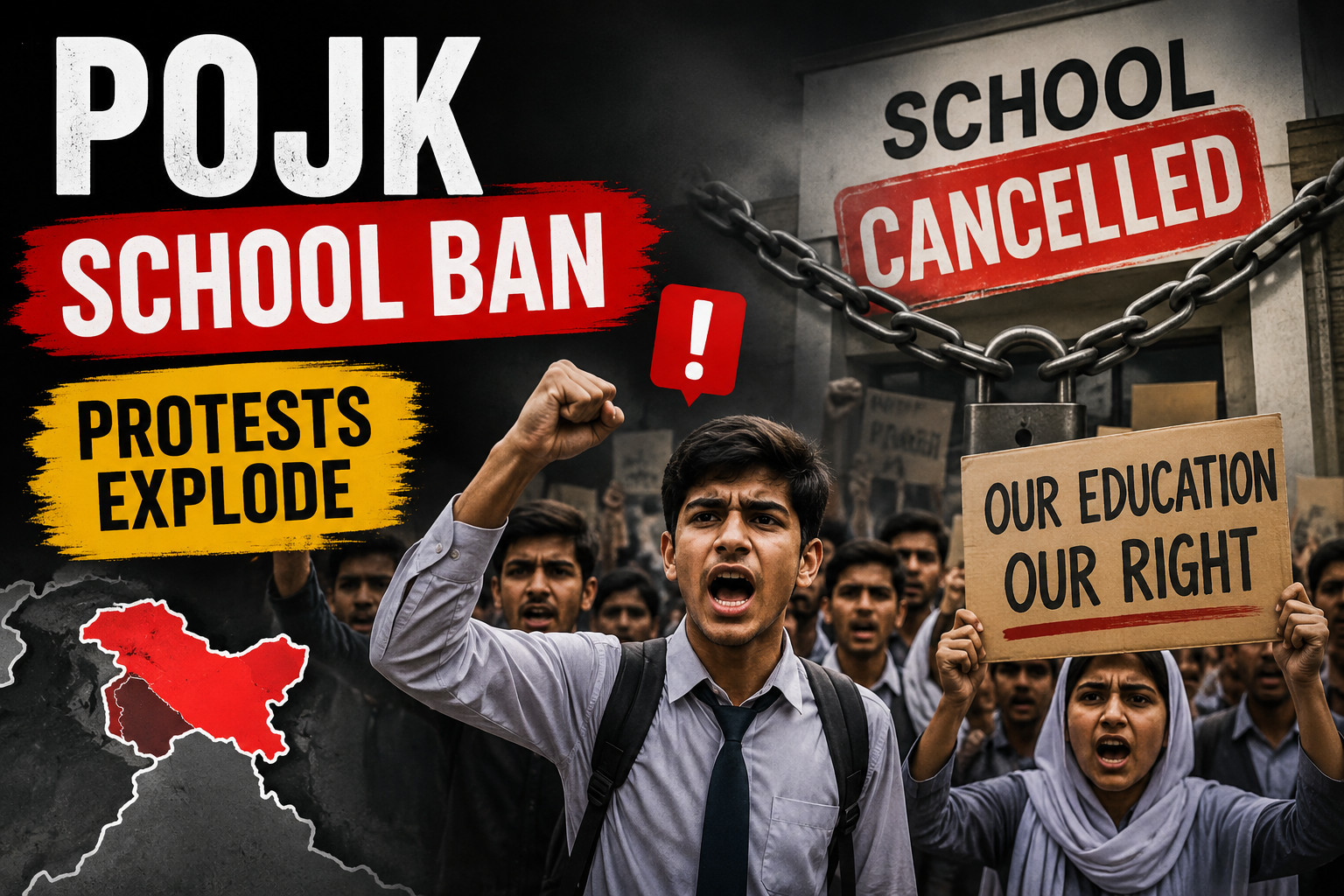
PoJK Unrest 2026: 13 Private Schools Deregistered, Students
Crackdown in PoJK: Private School Deregistration Sparks Widespread Unrest Across Pakistan-Occupied Kashmir
In recent weeks, Pakistan-occupied Jammu & Kashmir (PoJK) has witnessed a surge of public anger that has transformed an educational dispute into a broader political and social crisis. The administration’s decision to cancel or suspend the registration of 13 private schools has triggered protests, road blockades, student rallies, and growing demands for judicial intervention.
While officials describe the move as a routine regulatory enforcement action, many residents view it as a harsh crackdown on already fragile educational institutions. The controversy has become a symbol of deeper frustrations related to inflation, unemployment, governance, and the perceived expansion of state control over local affairs.
This article examines the background of the crisis, the educational realities of PoJK, the reasons behind the public backlash, and the possible consequences if the standoff continues.
What Triggered the Current Crisis?
The immediate spark came when educational authorities issued notifications revoking the registration and operational status of 13 private institutions. These actions followed earlier enforcement measures that had reportedly affected hundreds of schools across multiple districts.
The official explanation
According to administrative notifications and local reporting, the affected schools were accused of:
-
Failing to complete mandatory registration renewals
-
Not submitting required institutional data under PEIRA-related regulations
-
Lacking updated safety, infrastructure, or compliance documentation
-
Deviating from officially approved curriculum or regulatory oversight procedures
From the government’s perspective, the action was intended to improve educational standards and ensure that institutions operate within the legal framework.
The public perception
For parents, teachers, and students, the decision appeared sudden and punitive. Many families argue that even if school managements were non-compliant, shutting down institutions without transition arrangements directly harms children. The timing has added to the anxiety, as many students are approaching board examinations and admission deadlines.
Understanding the Educational Reality of PoJK
To understand why the issue has generated such intense public reaction, it is essential to look at the region’s educational structure.
PoJKEstimated educational landscape
Total institutions
~2,500+
Registered and unregisteredStudents relying on private schools
45%+
Primary and secondary levelsGovernment schools lacking labs/computers
35–40%
Infrastructure deficitSchools affected by recent sanctions
400+
Across roughly 10 districtsDependence on private education
Private schools have become a critical pillar of education in PoJK. In many towns and semi-urban areas, families prefer private institutions because of better attendance, English-medium instruction, and comparatively stronger examination results.
Government infrastructure constraints
Public schools in several districts face shortages of laboratories, computer facilities, trained teachers, and classroom space. As a result, the state system is not in a position to rapidly absorb large numbers of displaced students.
A pattern seen elsewhere
Similar regulatory disputes in other Pakistani-administered regions have previously led to delays in examination registration and protests by students who feared losing an academic year. This history has made families particularly sensitive to any disruption in school affiliation.
Why the Public Reaction Has Been So Strong
The anger is not only about 13 schools. The controversy has become a focal point for wider grievances.
Fear of academic loss
Parents are concerned that:
-
Board examination forms may be rejected
-
Students may lose eligibility for upcoming exams
-
Transfer procedures could take months
-
An entire academic session could be wasted
For families with limited financial resources, even a few months of disruption can have long-term consequences.
Economic pressure
The region has already experienced significant economic stress.
-
Rising food prices
-
Higher electricity costs
-
Reduced household purchasing power
-
Limited employment opportunities for youth
Teachers, clerical staff, transport operators, and other workers connected to private schools now fear loss of income, which broadens the impact beyond students alone.
Perception of administrative overreach
Civil society groups and school associations argue that the government is using regulatory mechanisms to tighten control over independent educational and community institutions. Whether or not this claim is accurate, the perception itself has become politically powerful.
How the Protests Escalated
Following the deregistration orders, demonstrations spread across several major districts.


Muzaffarabad
Students gathered outside press clubs and government offices, demanding restoration of school licenses and protection of examination rights.
Rawalakot
Parent-teacher alliances emerged as a major force, with associations warning of district-wide shutdowns if the administration did not offer relief.
Kotli and Mirpur
Protests included road blockades, sit-ins, and public meetings criticizing what demonstrators called administrative mismanagement.
Security deployment
Police and law enforcement personnel were deployed around education department offices and other sensitive locations to prevent escalation and maintain traffic movement.
The Political Dimension
Education disputes in PoJK rarely remain purely administrative. The region’s political environment is shaped by competing narratives of governance, autonomy, and representation.
The school controversy has intersected with:
-
Earlier protests over electricity and flour prices
-
Demands for greater local decision-making
-
Criticism of bureaucratic centralization
-
Growing youth dissatisfaction
As a result, the issue now carries symbolic weight beyond the education sector.
Impact on Students
The most immediate consequences are being felt by students.
Potential student impacts
-
Uncertainty regarding board examination eligibility
-
Delays in registration and documentation
-
Difficulty obtaining transfer certificates
-
Psychological stress and anxiety
-
Disruption of coaching and preparation schedules
-
Risk of increased dropout rates among vulnerable families
Educational experts often warn that prolonged uncertainty can damage student motivation even if formal classes eventually resume.
What Are School Associations Demanding?
Private school representatives have put forward several key demands:
-
Immediate suspension of cancellation orders
-
A grace period of 15–30 days for compliance
-
Protection of students’ examination status
-
Transparent inspection procedures
-
Consultation with school owners before punitive action
-
Independent review of disputed cases
They argue that compliance can be improved without abruptly shutting down institutions.
Could the Courts Intervene?
Legal action is increasingly likely.
Possible judicial outcomes include:
|
Possible court action |
Likely effect |
|---|---|
|
Temporary stay order |
Schools may continue operating while the case is heard |
|
Conditional restoration |
Institutions allowed to function subject to compliance deadlines |
|
Support for administration |
Deregistration remains in force |
|
Independent inquiry |
Fresh review of inspection and cancellation process |
Courts may place particular emphasis on protecting students from irreparable academic harm.
The Administration’s Dilemma
The authorities now face a difficult balancing act.
Enforce regulations
Maintain standards, safety, and legal oversightProtect academic continuity
Avoid disrupting exams and student progressionContain economic fallout
Prevent job losses and pressure on householdsPrevent wider unrest
Keep protests from evolving into a broader movementA rigid approach may deepen public resentment, while a complete rollback could weaken the credibility of future regulatory enforcement.
Possible Scenarios in the Coming Weeks
Scenario 1: Negotiated compromise
This is currently the most likely outcome. Schools receive a compliance window, students are protected, and inspections continue under revised timelines.
Scenario 2: Prolonged confrontation
If neither side backs down, protests could intensify and spread, increasing political pressure on the administration.
Scenario 3: Judicial freeze
Court intervention could temporarily pause the deregistration orders, shifting the battle from the streets to the legal arena.
Scenario 4: Partial reopening
Some schools may regain conditional approval while others remain closed, creating a mixed and potentially confusing situation.
A Deeper Structural Problem
The crisis highlights a larger question: Can educational regulation succeed in a region where public infrastructure remains insufficient?
Experts often argue that enforcement without parallel investment creates instability. Effective reform usually requires:
-
Upgrading government schools
-
Expanding teacher recruitment
-
Improving inspection transparency
-
Digitizing compliance systems
-
Providing transition mechanisms for students
-
Engaging communities before major policy shifts
Without these measures, regulatory actions can appear punitive rather than developmental.
Why This Story Matters Beyond PoJK
The controversy reflects a broader challenge seen in many developing regions: the tension between state regulation and educational access.
When private institutions become essential because public systems are weak, governments face a paradox. They must regulate these institutions, but overly abrupt enforcement can disrupt the very access that millions depend upon.
This makes the PoJK episode relevant not only as a regional political story, but also as a case study in governance, education policy, and public trust.
Conclusion
The cancellation of 13 private school registrations in Pakistan-occupied Jammu & Kashmir has become far more than an administrative dispute. It has exposed deep vulnerabilities in the region’s educational infrastructure, amplified existing economic frustrations, and triggered a wider debate about governance and public welfare.
At the heart of the crisis are thousands of students whose academic futures have been thrown into uncertainty. Whether the administration chooses negotiation, legal confrontation, or conditional restoration will determine not only the fate of the affected schools but also the level of public trust in state institutions.
If a balanced solution is not reached soon, the unrest is likely to continue—and the cost will be borne first and foremost by the students the education system is supposed to protect.