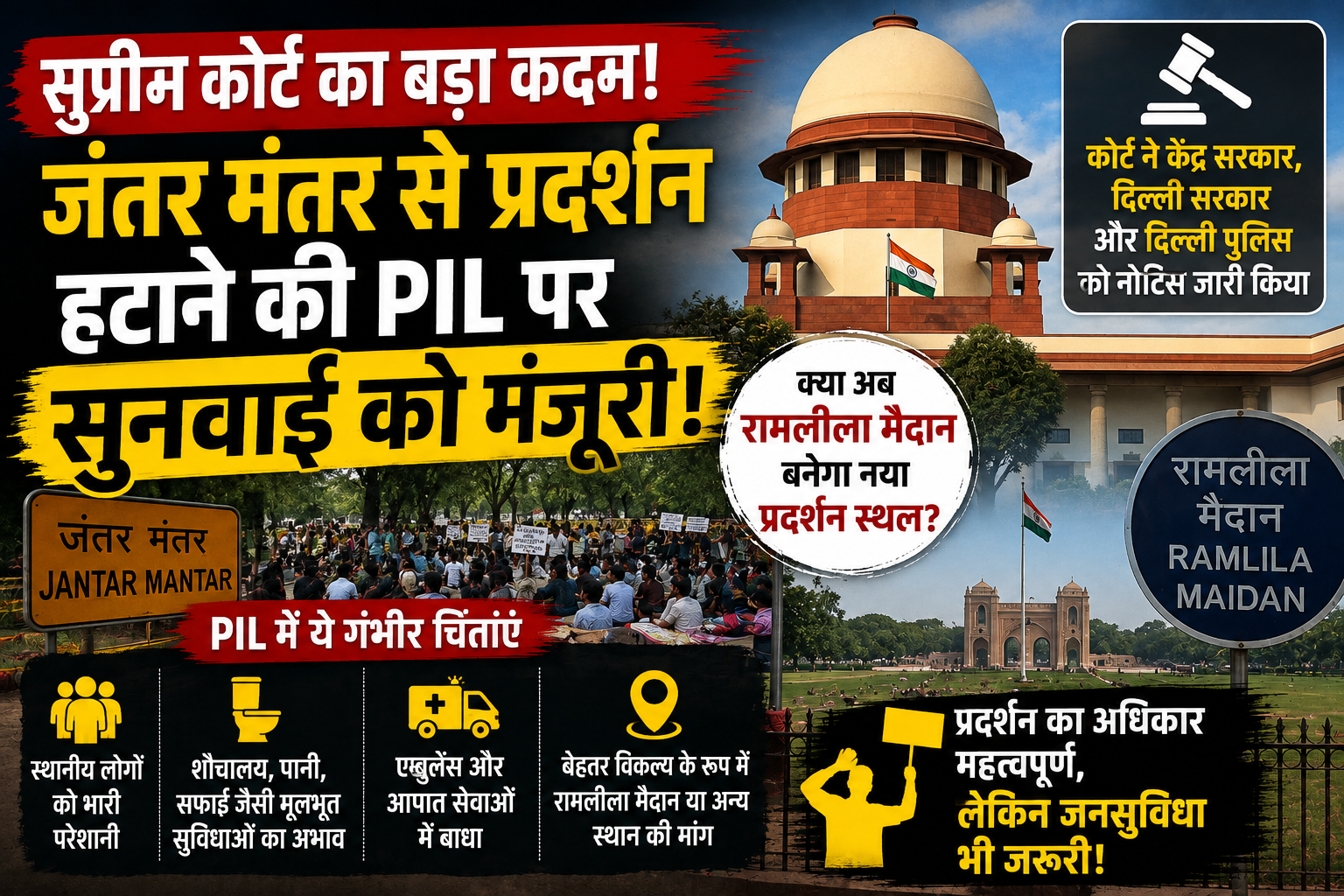
Supreme Court Hear PIL Shifting Jantar Mantar Protest Site
Supreme Court Agrees to Hear PIL Seeking Relocation of Protest Site from Delhi’s Jantar Mantar
In an important development involving the balance between the right to protest and urban civic administration, the Supreme Court of India has agreed to hear a Public Interest Litigation (PIL) seeking the relocation of the designated protest site from Delhi’s Jantar Mantar to another venue with better infrastructure and less impact on local residents.
The matter was considered by a bench headed by Chief Justice Surya Kant, along with Justice Joymalya Bagchi and Justice V. Mohana. The Court issued notices to the Central Government, the Government of NCT of Delhi, and the Commissioner of Delhi Police, asking them to respond to the concerns raised in the petition.
The case has revived a long-standing debate in Delhi: Where should citizens exercise their democratic right to protest, and how should the State manage the competing rights of residents, commuters, businesses, and emergency services?
Why Jantar Mantar Matters
Jantar Mantar is not just a historic astronomical observatory built in the 18th century; for decades it has also functioned as one of the most recognizable protest locations in India.
Located in the heart of Lutyens’ Delhi, close to Parliament Street, Connaught Place, government offices, hotels, and residential areas, it has been used by:
-
Farmers’ groups
-
Students
-
government job aspirants
-
Trade unions
-
Social movements
-
Political organizations
-
Civil society campaigns
Because of its symbolic proximity to the country’s power centers, many groups consider Jantar Mantar a place where their voice can be heard most effectively.
What Does the PIL Seek?
The petition was filed by Advocate Satish Chand Kaushik. It does not seek a ban on protests. Instead, it asks the Court to direct authorities to identify and develop an alternative, infrastructure-ready protest venue, such as Ramlila Maidan or another designated location.
The core argument is that Jantar Mantar has become unsuitable for large-scale and continuous demonstrations.
Key Concerns Raised in the Petition
1. Inconvenience to Residents and Office-Goers
The petitioner argues that repeated protests affect:
-
Entry and exit routes
-
Local traffic movement
-
Commercial activity
-
Daily life of residents and employees in the area
Since the locality contains both residential and commercial establishments, disruptions are felt beyond the protest site itself.
2. Lack of Basic Civic Infrastructure
According to the petition, the area lacks adequate facilities for large gatherings, including:
-
Public toilets
-
Drinking water
-
Waste disposal systems
-
Sewage arrangements
-
Medical assistance points
The PIL contends that when demonstrations continue for extended periods, the absence of such facilities creates sanitation and public health concerns.
3. Impact on Emergency Services
One of the more serious concerns relates to the movement of:
-
Ambulances
-
Fire services
-
Police vehicles
-
Essential supply vehicles
The petitioner claims that traffic congestion associated with major demonstrations can delay emergency response in the surrounding area.
Supreme Court’s Initial Observations
During the hearing, the bench treated the issue as one involving public convenience and civic management.
Chief Justice Surya Kant asked the Solicitor General to obtain instructions from the concerned authorities regarding the practical concerns highlighted in the petition.
The Court did not make any final observation on whether Jantar Mantar should be shifted as a protest venue. At this stage, it has only sought responses from the governments and police authorities.
This Is Not the First Legal Battle Over Jantar Mantar
The issue has a significant judicial history.
2017: National Green Tribunal (NGT) Order
The NGT imposed restrictions on protests at Jantar Mantar, citing:
-
Noise pollution
-
Sanitation problems
-
Environmental concerns
-
Disturbance to local residents
The tribunal suggested that Ramlila Maidan could serve as an alternative protest location.
2018: Supreme Court’s Landmark Judgment
In Mazdoor Kisan Shakti Sangathan v. Union of India (2018), the Supreme Court set aside the blanket prohibition and emphasized that:
Peaceful protest is a constitutional right
Article 19(1)(b) guarantees citizens the right to assemble peacefully and without arms.
Rights must be balanced
Residents also have rights to peaceful living, movement, health, and dignity under Article 21.
The Court directed authorities to frame a balanced regulatory framework rather than impose an absolute ban.
This judgment remains the most important constitutional precedent governing protests at Jantar Mantar.
The Constitutional Question
The current PIL essentially asks the Court to revisit the administrative implementation of that balance.
Article 19(1)(b): Right to Assemble
Citizens have the right to gather peacefully and express dissent.
Article 21: Right to Life and Dignity
Residents and commuters have the right to:
-
Peaceful living
-
Health
-
Mobility
-
Access to emergency services
The challenge is that both rights are fundamental, and neither automatically overrides the other.
Why Ramlila Maidan Is Being Suggested
Ramlila Maidan has often been used for large political and social gatherings.


6
Supporters of relocation argue that it offers:
-
More open space
-
Better crowd management
-
Easier traffic diversion
-
Scope for temporary sanitation facilities
-
Better emergency access
However, critics of relocation say that moving protests farther from central administrative zones may reduce their visibility and democratic impact.
Delhi Police and Protest Management
Delhi Police already regulates demonstrations through permissions, route restrictions, time limits, and security arrangements.
In recent years, authorities have increasingly used:
-
Barricading
-
Designated protest zones
-
Crowd-control measures
-
Traffic diversions
-
Conditions attached to permissions
The PIL argues that these measures are insufficient when large numbers gather repeatedly at Jantar Mantar.
Civic Experts: A Need for Planned Protest Infrastructure
Urban governance experts often point out that modern cities require purpose-built protest infrastructure.
Possible features include:
-
Large assembly areas
-
Public toilets
-
Drinking water stations
-
Medical booths
-
Waste management systems
-
Parking and public transport access
-
Emergency corridors
-
Digital permission and monitoring systems
The debate is therefore not only about shifting protests, but about whether democratic dissent should be supported through proper civic infrastructure.
Concerns About Relocation
Civil liberties advocates have raised important concerns.
Symbolic distance
Jantar Mantar is close to the seat of power; shifting protests may weaken symbolic communication.
Accessibility
Smaller organizations may find larger venues more expensive or difficult to access.
Incremental restriction
Some fear that relocation could gradually lead to tighter controls on public demonstrations.
These concerns will likely feature prominently when the matter is heard further.
What Happens Next?
The Supreme Court has asked the respondents to file their replies. The next stages may include:
Replies from Centre, Delhi Government, and Delhi Police
Examination of traffic, sanitation, and security data
Assessment of alternative protest sites
Consideration of stricter guidelines instead of relocation
Possible directions for a comprehensive protest-management framework
At present, no final decision has been taken on shifting the protest site.
A Larger National Debate
The case has implications beyond Delhi.
Cities across India increasingly face tensions between:
-
Democratic expression
-
Traffic management
-
Environmental concerns
-
Public health
-
Security requirements
-
Residents’ rights
Questions being asked include:
-
Should every major city have a dedicated protest zone?
-
How close should protests be allowed to government institutions?
-
What infrastructure must the State provide for lawful assemblies?
-
Can restrictions become excessive?
The Supreme Court’s eventual ruling may influence how authorities approach protest management in other urban centers as well.
Conclusion
The Supreme Court’s decision to hear the PIL seeking relocation of protests from Jantar Mantar marks another significant chapter in India’s evolving constitutional conversation on dissent, public space, and urban governance.
The petition does not challenge the right to protest itself; it questions whether Jantar Mantar remains an appropriate venue for large and recurring demonstrations. On the other side, any relocation proposal must be examined carefully to ensure that administrative convenience does not dilute democratic freedoms.
The 2018 Supreme Court judgment established that peaceful protest is a fundamental right, but it must coexist with the rights of residents and the practical needs of the city. The current proceedings will test how that balance should be implemented in a densely populated capital.
Whether the Court ultimately endorses relocation, imposes stricter regulations, or directs the creation of better infrastructure at Jantar Mantar, the outcome is likely to shape the future of protest management in Delhi and potentially set an important precedent for other Indian cities.