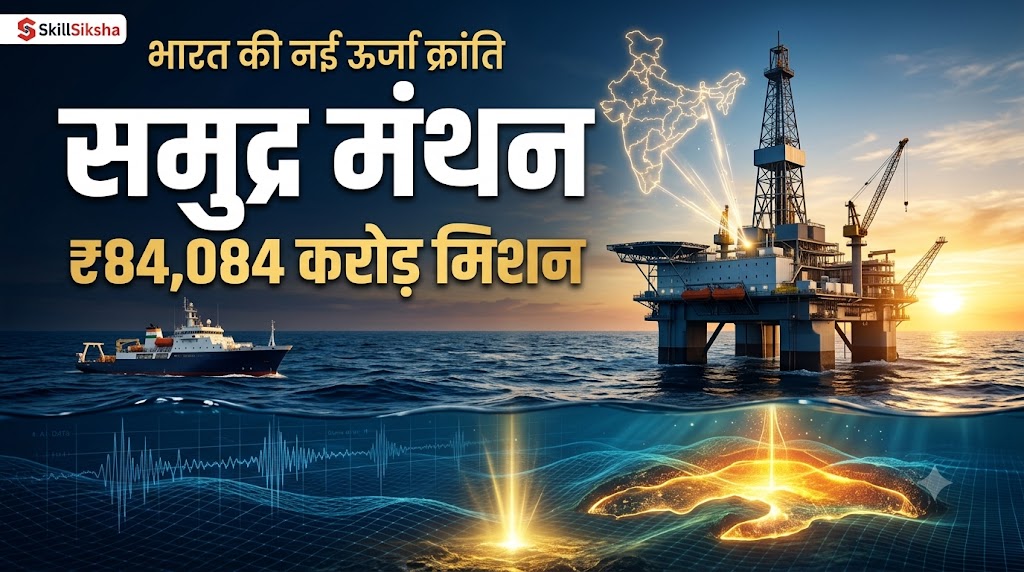
Samudra Manthan Scheme 2026
Samudra Manthan Scheme 2026: Cabinet Approves ₹84,084 Crore Mega Offshore Oil & Gas Exploration Mission
India has taken a major step toward strengthening its long-term energy security. The Union Cabinet, chaired by Prime Minister Narendra Modi, has approved the National Offshore Exploration Scheme, officially named “Samudra Manthan”, with a massive outlay of ₹84,084 crore to be implemented up to financial year 2030–31.
The decision is being seen as one of the largest upstream energy initiatives undertaken by India in recent years. The scheme focuses on accelerating offshore oil and gas exploration, improving geological data, developing shared infrastructure, and promoting domestic manufacturing for the petroleum sector.
Unlike many speculative claims circulating online, this article is based on the officially announced features of the scheme and publicly available government information.
Why India Needs a Scheme Like Samudra Manthan
India is the world’s third-largest consumer of crude oil, but a significant portion of its energy needs is met through imports. According to government data, India’s crude oil import dependency has risen to around 88.7% in 2025–26, compared with 78.5% in 2014–15.
This growing dependence creates several challenges:
-
Pressure on foreign exchange reserves
-
Exposure to global oil price shocks
-
Vulnerability to geopolitical disruptions
-
Higher import bills during periods of market volatility
To address these concerns, the government has been pursuing a multi-pronged energy strategy that includes renewable energy expansion, biofuels, natural gas infrastructure, and enhanced domestic exploration. Samudra Manthan is the offshore exploration pillar of this strategy.
What Is the Samudra Manthan Scheme?
The scheme aims to accelerate the exploration and development of hydrocarbon resources located in India’s offshore areas, including deepwater, ultra-deepwater, and other under-explored regions within India’s Exclusive Economic Zone (EEZ).
The name “Samudra Manthan” draws inspiration from Indian heritage, symbolizing the churning of the ocean to obtain valuable resources. In policy terms, it represents the effort to unlock energy resources lying beneath India’s seas through advanced technology, data analysis, and risk-sharing mechanisms.
The scheme is being implemented by the Ministry of Petroleum and Natural Gas.
Total Financial Outlay: ₹84,084 Crore
The approved outlay is distributed across four major components.
| Component | Budget |
|---|---|
| Exploration and drilling incentives | ₹43,200 crore |
| Data acquisition and AI-based reprocessing | ₹28,534 crore |
| Shared offshore infrastructure | ₹10,000 crore |
| Oil and gas manufacturing and services zones | ₹2,000 crore |
Let us understand each component in detail.
1. Exploration and Drilling Incentives (₹43,200 Crore)
This is the largest component of the scheme.
Deepwater exploration is extremely expensive and risky. Companies may spend hundreds of crores on drilling a single exploratory well without any guarantee of finding commercially viable oil or gas.
Under the approved framework:
-
The government will provide up to 50% support for eligible drilling costs.
-
The support is capped at ₹675 crore per well.
-
The scheme is designed for 60 deepwater exploratory units/wells.
Why is this important?
Private and international companies often hesitate to invest in frontier basins because of geological uncertainty. By sharing part of the exploration risk, the government hopes to attract greater participation from:
-
Domestic private companies
-
Public sector explorers
-
Global oil and gas firms with deepwater expertise
This does not mean that the government is guaranteeing profits. It is a risk-sharing mechanism intended to encourage exploration activity.
2. Data Acquisition and AI-Based Reprocessing (₹28,534 Crore)
Accurate geological data is the foundation of successful exploration. A large portion of India’s offshore areas remains under-explored or inadequately mapped.
Budget breakup
-
₹12,000 crore for high-resolution 2D seismic surveys
-
₹12,534 crore for 3D seismic surveys
-
₹4,000 crore for reprocessing data in the National Data Repository (NDR) using Artificial Intelligence and advanced analytics
What are seismic surveys?
Seismic surveys use sound waves to create images of rock formations beneath the seabed. 3D surveys provide much more detailed subsurface imaging than older 2D methods.
Role of AI
The use of AI is aimed at:
-
Reinterpreting old seismic data
-
Identifying overlooked prospects
-
Improving drilling success rates
-
Reducing exploration uncertainty
This is one of the most technology-oriented aspects of the scheme.
3. Shared Offshore Infrastructure (₹10,000 Crore)
Many offshore discoveries are relatively small. Individually, they may not justify the cost of pipelines, processing facilities, and evacuation systems.
To address this, the scheme proposes development of common or shared infrastructure, which may include:
-
Offshore processing facilities
-
Subsea systems
-
Pipelines
-
Evacuation networks
-
Support infrastructure for multiple fields
Expected benefit
Smaller discoveries that are currently uneconomical could become commercially viable when connected to shared infrastructure.
This approach is already used in several mature offshore producing regions around the world.
4. Oil & Gas Manufacturing and Services Zones (₹2,000 Crore)
This component is linked to the Make in India initiative.
The government plans to support integrated zones for:
-
Offshore equipment manufacturing
-
Engineering services
-
Maintenance and repair
-
Fabrication
-
Specialized oilfield services
Why does this matter?
India currently imports a significant amount of high-end offshore equipment and technology. Building domestic capability could:
-
Reduce import dependence
-
Create skilled jobs
-
Strengthen the industrial supply chain
-
Support future offshore projects
Targets Set Under the Scheme
The government has outlined several long-term objectives to be achieved by 2030–31.
Hydrocarbon reserve accretion
More than 600 MMTOE targeted
Resource base expansion
From 1.6 billion TOE to 2.2 billion TOE
Domestic production increase
From about 62 MMTOE to 80 MMTOE annually
Potential import savings
Up to about ₹1 lakh crore annually
These are policy targets and projections, not guaranteed outcomes. Actual results will depend on exploration success, commercial viability, global prices, and project execution.
Understanding Deepwater and Ultra-Deepwater Exploration
To appreciate the scale of the challenge, it is important to understand what deepwater exploration involves.


7
Deepwater
Generally refers to water depths greater than 400 meters.
Ultra-deepwater
Typically refers to depths greater than 1,500 meters.
Operations in such environments require:
-
Advanced drilling rigs
-
High-pressure equipment
-
Subsea production systems
-
Remote-operated vehicles
-
Complex safety systems
A single exploratory well can cost over $100 million, and commercial production may begin many years after discovery.
This is why government support is considered important for frontier exploration.
How Samudra Manthan Differs from Earlier Policies
India has undertaken offshore exploration for decades through ONGC and other operators. However, the new scheme differs in several ways.
| Earlier approach | Samudra Manthan approach |
|---|---|
| Limited risk-sharing | Significant drilling incentives |
| Conventional data interpretation | AI-based reprocessing |
| Project-specific infrastructure | Shared infrastructure model |
| Less emphasis on manufacturing ecosystems | Dedicated manufacturing and services zones |
The scheme therefore attempts to address the entire exploration ecosystem rather than only drilling activity.
Opening of Previously Restricted Offshore Areas
In recent years, the government has opened large offshore areas that were earlier subject to restrictions. The availability of new acreage, combined with improved seismic data and financial incentives, is expected to increase interest in future bidding rounds.
For international investors, three factors are particularly important:
-
Access to acreage
-
Quality of geological data
-
Fiscal and risk-sharing terms
Samudra Manthan seeks to improve all three.
Economic Impact Beyond Oil Production
The scheme is not only about producing more oil and gas.
Potential economic benefits
-
High-skilled employment
-
Growth of offshore engineering
-
Fabrication industry expansion
-
Marine logistics services
-
Data and geoscience services
-
AI and digital energy applications
-
Export potential for engineering services
If implemented effectively, the multiplier effects could extend to shipyards, steel, electronics, automation, and coastal industrial clusters.
Environmental and Regulatory Considerations
Offshore exploration also carries environmental responsibilities.
The projects under the scheme will continue to be subject to:
-
Environmental clearances
-
Offshore safety regulations
-
Disaster management norms
-
Marine pollution control standards
-
Monitoring by relevant regulatory authorities
The expansion of exploration does not remove existing environmental compliance requirements.
Challenges Ahead
Despite the ambitious vision, several challenges remain.
Exploration risk
Many wells may not lead to commercial discoveries.
Cost escalation
Offshore projects are vulnerable to inflation and equipment costs.
Long gestation periods
Production may take several years after discovery.
Global energy transition
Long-term demand patterns are evolving.
Execution capacity
Coordination across agencies and industry is essential.
Success will depend not only on budget allocation but also on timely execution and sustained investor confidence.
What Does This Mean for India’s Energy Future?
India is pursuing a dual-track strategy:
Clean energy expansion
Solar, wind, storage, green hydrogen, and other low-carbon energy sources continue to expand rapidly.
Domestic hydrocarbon strengthening
Oil and gas remain important for transport, industry, fertilizers, petrochemicals, and overall energy security.
The government’s position is that hydrocarbons will continue to play an important role in the Indian economy for the foreseeable future, even as renewable energy grows rapidly.
In that context, Samudra Manthan is intended to reduce dependence on imported hydrocarbons rather than increase dependence on fossil fuels overall.
Conclusion
The approval of the ₹84,084 crore Samudra Manthan scheme marks a significant policy shift in India’s offshore energy strategy. By combining drilling incentives, advanced seismic data acquisition, AI-driven interpretation, shared infrastructure, and domestic manufacturing support, the government is attempting to create a comprehensive ecosystem for deepwater exploration.
Whether the scheme ultimately delivers the targeted reserve additions and import savings will depend on geological success, execution efficiency, investor participation, and global energy dynamics. However, the initiative clearly signals that India is making a serious long-term effort to strengthen its domestic energy base.
For students, policymakers, investors, and industry observers, Samudra Manthan is not merely another subsidy program. It is a strategic attempt to improve India’s energy resilience at a time when global energy markets remain uncertain and geopolitical risks continue to influence supply chains and prices.
As India moves toward its broader Viksit Bharat 2047 vision, the success of offshore exploration will be closely watched as one of the key components of the country’s economic and energy security architecture.