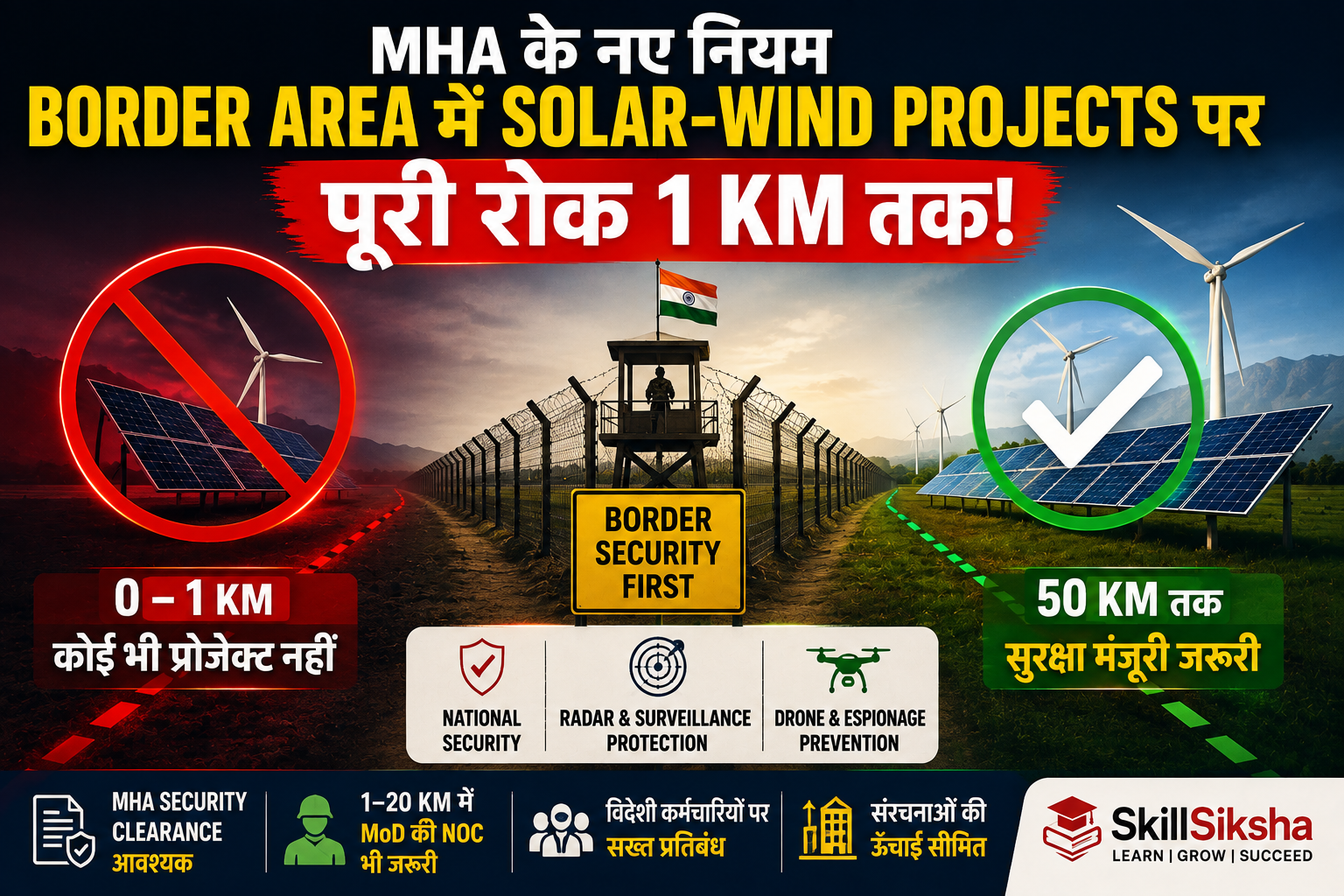
MHA Bans New Solar & Wind Projects Within 1 Km of India’s
MHA Issues National Security Guidelines for Renewable Energy Projects Near India’s Borders: What the New 1 Km Ban Means
By skillsiksha Editorial Team | Published: August 11, 2026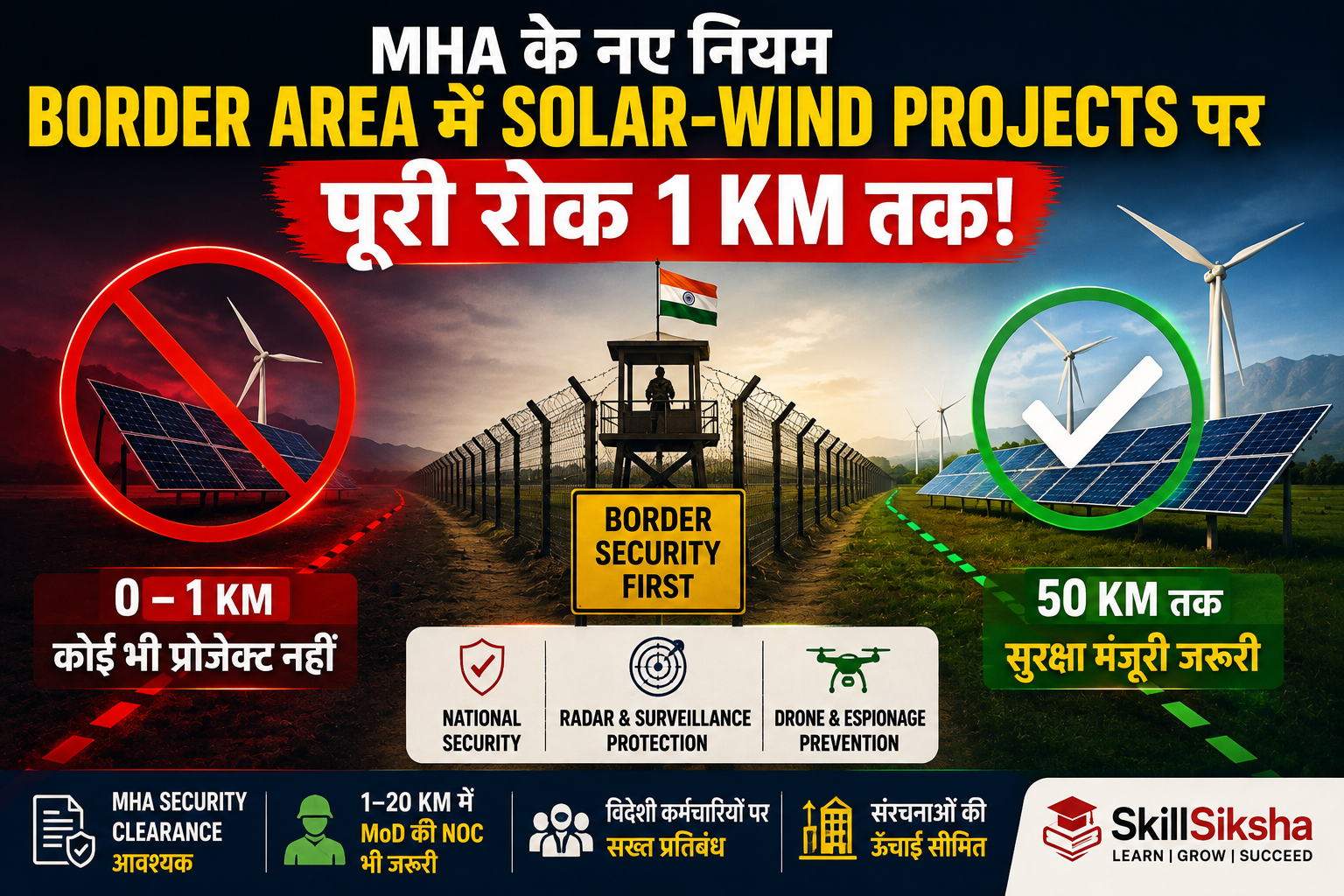
In a major policy development linking clean energy expansion with national security, the Ministry of Home Affairs (MHA) has issued a new framework for renewable energy projects located near India’s international borders.
The guidelines apply to solar, wind, and hybrid renewable energy projects situated close to the International Border (IB), Line of Control (LoC), and Line of Actual Control (LAC). The most significant provision is a complete prohibition on any new renewable energy project within 1 kilometer of these border lines.
The move comes at a time when India is rapidly expanding its renewable energy capacity while simultaneously strengthening surveillance, air defence, and infrastructure security along sensitive frontiers with Pakistan, China, and Bangladesh.
This article explains the new rules, the security concerns behind them, the approval process, and their likely impact on the renewable energy sector.
Why Did the Government Issue These Guidelines?
India has set ambitious renewable energy targets and is developing large-scale solar and wind parks across several states. Many of the most suitable locations for such projects are found in:
-
Rajasthan
-
Gujarat
-
Punjab
-
Ladakh
-
Jammu & Kashmir
These regions often contain vast stretches of low-population land with high solar radiation or strong wind potential. However, the same areas are also strategically sensitive from a national security perspective.
According to the new framework, the government believes that certain types of renewable energy infrastructure near borders could create operational challenges for security agencies.
The Most Important Change: Complete Ban Within 1 Km
Under the new MHA guidelines:
0–1 Km from IB, LoC, and LAC
No new solar, wind, or hybrid renewable energy project can be set up within 1 kilometer of the border.
Applies to all project activities
This includes construction, installation, and related project activity.
This is being treated as a zero-development security buffer.
The Distance-Wise Approval System
The government has introduced a tiered regulatory structure.
| Distance from Border | Requirement |
|---|---|
| 0–1 Km | Completely prohibited |
| 1–20 Km | MHA Security Clearance + MoD NOC |
| 20–50 Km | MHA Security Clearance |
| Beyond 50 Km | Normal state and environmental approvals |
This means that even projects located up to 50 km from the border will face additional scrutiny.
What Types of Projects Are Covered?
The rules apply to:
-
Ground-mounted solar parks
-
Wind power projects
-
Solar-wind hybrid projects
-
Associated transmission and operational infrastructure connected to these projects
Rooftop solar installations in ordinary urban areas are not the focus of these guidelines.
Security Concerns Behind the Policy
1. Radar and Surveillance Interference
Large wind turbines can affect radar performance, while extensive solar arrays may create reflective effects in certain conditions.
Security agencies are concerned about:
-
Radar shadow zones
-
Electromagnetic interference
-
Reduced effectiveness of surveillance systems
-
Blind spots in sensitive sectors
These concerns are particularly relevant in areas where military radar and border monitoring systems operate continuously.
2. Drone and Espionage Risks
Modern renewable energy parks require:
-
Regular maintenance
-
Technical inspections
-
Drone-based surveys
-
Mapping and monitoring activities
The government fears that such activities near the border could be misused for:
-
Unauthorized aerial observation
-
Terrain mapping
-
Surveillance of security installations
-
Intelligence gathering
3. Movement of Personnel
Large projects bring a steady flow of:
-
Engineers
-
Contractors
-
Technicians
-
Labourers
-
Transport operators
In high-security border zones, authorities want tighter control over who can access these areas.
Restrictions on Foreign Personnel
One of the stricter provisions relates to workers from countries that share a land border with India.
Developers cannot employ personnel from such countries without prior approval from the central government.
This provision is particularly relevant for nationals of:
-
China
-
Pakistan
-
Bangladesh
The rule reflects broader national security restrictions that have emerged in several sectors after recent geopolitical tensions.
Height Restrictions on Structures
To preserve clear lines of sight for security forces, the guidelines impose height limits on certain civil structures associated with renewable projects.
1–8 Km
3 meters
8–20 Km
5 meters
20–50 Km
15 meters
These limits apply mainly to operation and maintenance buildings and other supporting structures.
Approval Process Through MNRE
Developers must route proposals through the Ministry of New and Renewable Energy (MNRE).
Required documents
-
State land allocation approval
-
Exact latitude and longitude coordinates
-
Project layout
-
Security-related details
-
Technical specifications
The system is intended to function as a single-window routing mechanism for security examination.
Mandatory Verification of Workers
All personnel working in the sensitive belt must undergo verification by local authorities and security agencies such as:
-
State Police
-
Border Security Force (BSF)
-
Army (where applicable)
This requirement is aimed at preventing unauthorized access to sensitive locations.
Anti-Drone and Security Infrastructure
For projects within the sensitive zone, developers may be required to support additional security measures, including:
-
Dedicated security posts
-
Surveillance systems
-
Anti-drone arrangements
-
Coordination with police or CISF
This could increase the overall cost of projects near border areas.
Land Transfer Restrictions
Project land cannot be transferred or leased to a foreign entity without prior approval from:
-
Ministry of Home Affairs
-
Central Government
This provision seeks to ensure long-term control over strategically located infrastructure.
Which States Will Be Most Affected?
Rajasthan
India’s largest solar state and home to several border districts.
Gujarat
Major solar and wind expansion areas near the Pakistan border.
Punjab
Border proximity may affect future large-scale projects.
Jammu & Kashmir and Ladakh
Strategically sensitive regions with growing renewable energy interest.
The impact will vary depending on the exact distance of proposed projects from the border.
Will Existing Projects Be Shut Down?
The current guidelines focus on new renewable energy projects. Existing operational projects are generally not being described as automatically cancelled.
However, future expansion, modification, or additional infrastructure may be subject to the new approval framework.
Impact on India’s Renewable Energy Goals
India has committed to substantial growth in non-fossil energy capacity. Industry observers are asking whether the new restrictions could slow investment in border districts.
Likely impact
Projects within 1 Km
Effectively impossible.
Projects within 1–20 Km
Longer approval timelines.
Security compliance costs
Likely to increase.
Project relocation
Some projects may move farther from the border.
Analysts do not expect a major national slowdown because most of India’s renewable potential lies beyond the 50 km sensitive belt.
Why the Government Calls It a Balancing Framework
The policy does not prohibit renewable energy development in border states altogether.
Instead, it creates three categories:
-
No-go zone
-
High-security approval zone
-
Sensitive approval zone
The government’s objective appears to be balancing:
Clean energy expansion
Military surveillance
Communication security
Air defence considerations
Control over strategic infrastructure
Quick Revision Notes for Exams
Issuing Ministry
MHA
Nodal routing ministry
MNRE
Complete ban
0–1 Km
MHA + MoD clearance
1–20 Km
MHA clearance
20–50 Km
Sensitive zone
50 Km
Personnel restriction
Border-sharing countries
The Bigger Picture: Green Energy Meets Geopolitics
The new MHA guidelines show how renewable energy is no longer viewed only through an environmental or economic lens. In strategically sensitive regions, it is increasingly connected to:
-
Border management
-
Critical infrastructure protection
-
Cyber and drone threats
-
Foreign influence concerns
-
National resilience
As India moves toward becoming a major clean-energy power, the government is also trying to ensure that energy infrastructure does not create vulnerabilities along contested or sensitive borders.
Conclusion
The MHA’s new border-area renewable energy guidelines represent one of the most significant security interventions in India’s clean-energy sector in recent years. The 1 km complete ban, combined with MHA and MoD scrutiny up to 50 km, creates a structured security framework for future projects near the IB, LoC, and LAC.
For developers, the message is clear: border renewable projects will now be treated as strategic infrastructure, not just commercial power assets.
For policymakers, the challenge will be ensuring that national security safeguards are implemented efficiently without creating unnecessary delays for legitimate clean-energy investments.
And for students preparing for competitive exams, this development is an important example of how India’s energy policy, internal security, and geopolitical considerations are increasingly becoming interconnected.
Related Articles

India-Austria Relations 2026: A Strategic Partnership for Defense & Trade
READ MORE →
NEET 2026 Paper Leak: How One Exam Can Destroy India’s Future
READ MORE →
Entertainment Industry Workers Dark Reality Behind Bollywood Superstars
READ MORE →
Assam Flood 2026: Why Does Assam Flood Every Year? Complete
READ MORE →
Birth and Death Amendment Bill 2026
READ MORE →
Jharkhand Students on the Streets: What Happened in the
READ MORE →