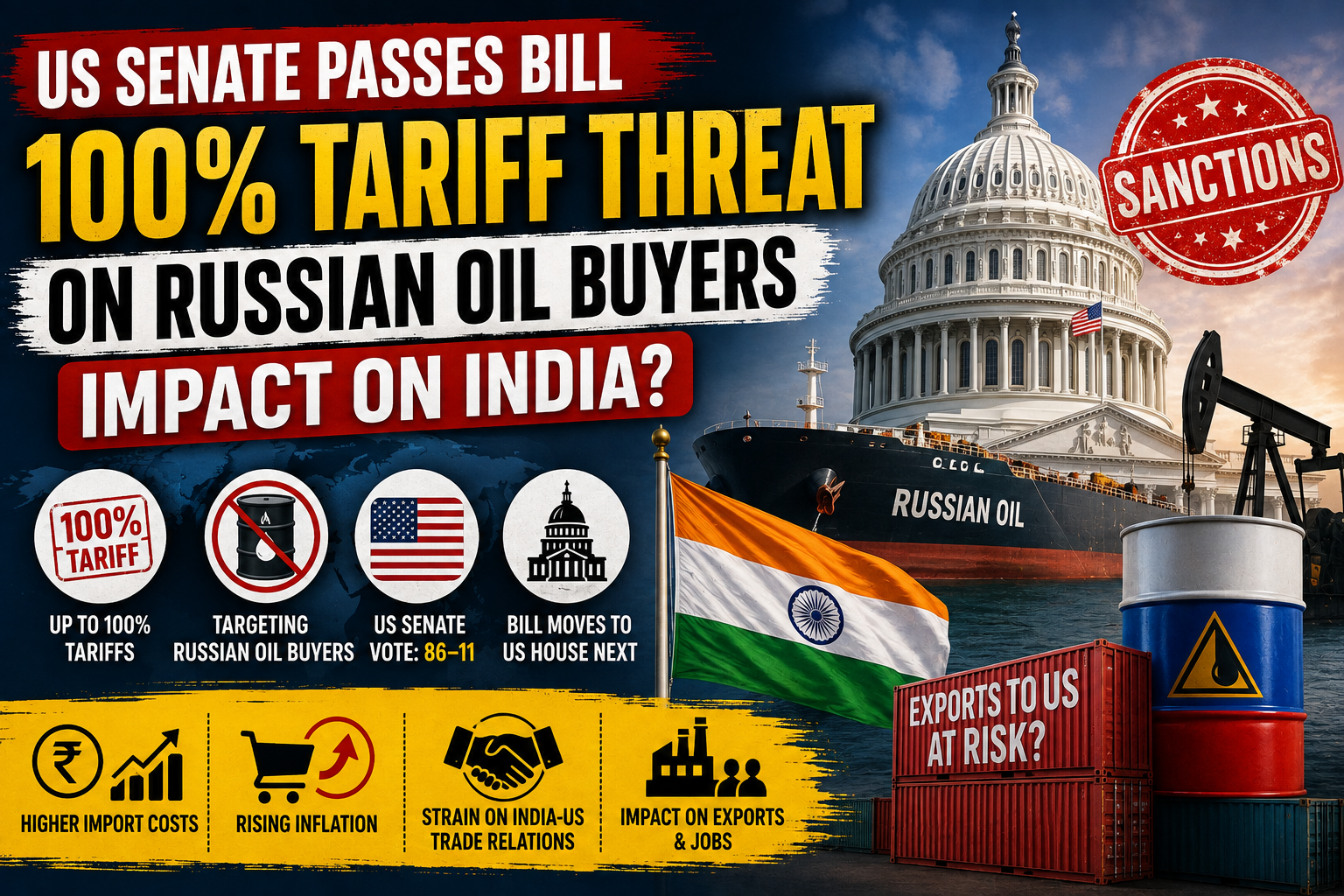
US Senate Passes Russia Sanctions Bill: Could 100% Tariffs
U.S. Senate Passes Russia Sanctions Bill: Could 100% Tariffs on Russian Oil Buyers Affect India?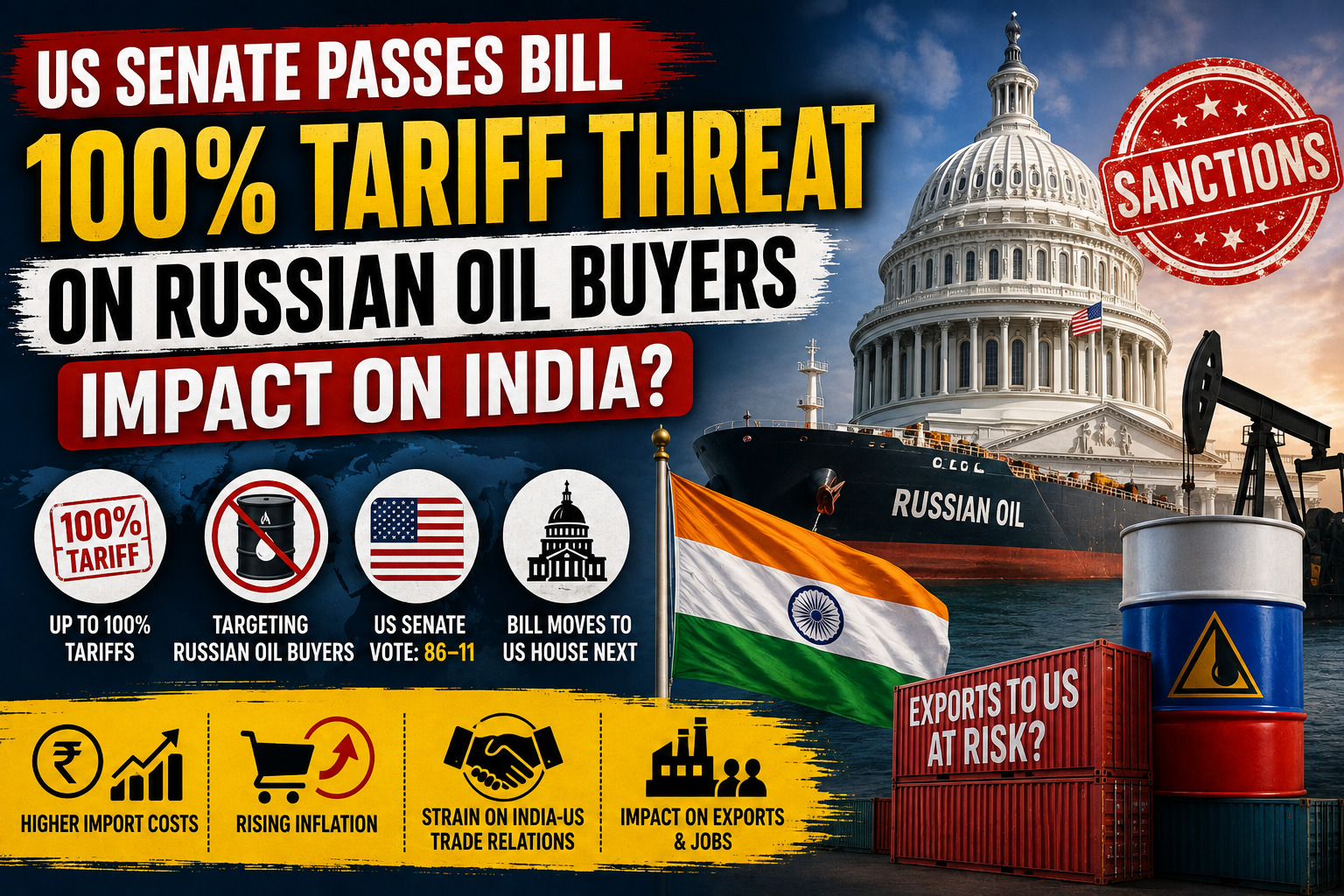
By skillsiksha Editorial Team | Published: August 11, 2026
In a major geopolitical and economic development, the U.S. Senate has passed a bipartisan sanctions bill aimed at increasing pressure on Russia and Iran. The legislation, approved by a reported 86–11 vote, has drawn particular attention in India because it includes provisions that could allow the U.S. President to impose secondary tariffs of up to 100% on imports from countries that continue to be among the largest buyers of Russian crude oil and natural gas.
The bill is officially titled the Lindsey O. Graham Sanctioning Russia and Iran Act of 2026.
While the legislation has not yet become law—it still requires approval by the U.S. House of Representatives and then the President’s signature—it has already triggered debate over its possible impact on global energy trade, India-U.S. relations, and India’s export economy.
This article explains what the bill contains, why India is being discussed, and what the realistic economic and diplomatic implications could be.
What Is the Bill About?
The legislation seeks to tighten economic pressure on Russia by targeting not only Russian entities but also countries that continue large-scale purchases of Russian energy.
Main provisions
-
Sanctions on Russian officials, oligarchs, banks, and shadow-fleet vessels.
-
Extension of the Iran Sanctions Act of 1996 until 2031.
-
Authority for the U.S. President to impose secondary tariffs of up to 100% on imports from major buyers of Russian oil and gas.
The key point is that the tariff provision is discretionary, not automatic.
Why Is India Being Mentioned?
Since the restructuring of global energy markets after 2022, India has significantly increased imports of discounted Russian crude oil.
Russia has become one of India’s largest crude suppliers, and in several recent months Russian oil has accounted for roughly 40–50% of India’s crude imports.
Because of this, India is being discussed alongside:
-
China
-
Azerbaijan
-
Hungary
-
Slovakia
as one of the major current buyers of Russian energy.
What Are “Secondary Tariffs”?
Traditional sanctions usually target the sanctioned country directly.
This bill goes a step further by potentially targeting third countries that continue substantial economic engagement with Russia.
The idea is to create a choice:
Continue large-scale Russian energy purchases
or
Preserve unrestricted access to the U.S. market
This is similar in concept to other forms of secondary sanctions previously used by the United States in areas such as Iran-related financial restrictions.
Has the 100% Tariff Been Imposed on India?
No.
This is the most important clarification.
As of now:
The bill has passed the U.S. Senate.
It has not yet passed the U.S. House.
It has not been signed into law.
No 100% tariff has been imposed on Indian exports.
The bill only creates a potential legal mechanism that could be used later.
Why Did India Buy More Russian Oil?
After Western sanctions on Russia in 2022, Russian crude was available at a discount compared with some other international grades.
India argued that:
-
It is a major energy-importing country.
-
Affordable crude helps control inflation.
-
Energy purchases are based on national interest and market conditions.
-
European countries also continued various forms of energy engagement during parts of the transition period.
The Indian government has consistently maintained that protecting the energy needs of its population is a legitimate policy objective.
How Important Is the U.S. Market for India?
The United States is one of India’s largest export destinations.
Major sectors include:
-
Pharmaceuticals
-
Engineering goods
-
Textiles
-
Gems and jewelry
-
Auto components
-
Chemicals
-
IT and business services
A very high tariff on goods exports would therefore be a serious concern if it were ever applied.
Possible Impact on India: A Scenario Analysis
Scenario 1: The Bill Does Not Become Law
-
No immediate impact.
-
Energy trade continues.
-
Diplomatic discussions continue.
Scenario 2: The Bill Becomes Law but India Receives a Waiver
The legislation reportedly contains a national-security waiver provision.
Possible consequences:
-
Limited or no tariff impact.
-
Continued negotiations.
-
Some pressure to diversify energy imports gradually.
Scenario 3: The Bill Becomes Law and Tariffs Are Applied
This would be the most severe scenario, though many analysts currently view it as less likely.
Potential effects:
-
Indian exports become much more expensive in the U.S.
-
Trade flows could be disrupted.
-
Pressure on manufacturing sectors.
-
Diplomatic tensions increase.
Energy Security vs. Inflation: India’s Dilemma
If India were to sharply reduce Russian oil imports, refiners would need to increase purchases from other suppliers such as:
-
Saudi Arabia
-
Iraq
-
UAE
-
Other international markets
The key question is price.
Higher crude procurement costs could eventually affect:
-
Petrol prices
-
Diesel prices
-
LPG costs
-
Transportation expenses
-
Overall inflation
The government would then face the challenge of balancing energy security, inflation control, and foreign policy considerations.
What About Indian Refineries?
Indian refiners have adapted to processing larger volumes of Russian crude.
A sudden change could involve:
-
Reconfiguring procurement strategies
-
Adjusting refinery economics
-
Managing shipping and insurance changes
-
Revising long-term supply contracts
This is one reason why abrupt policy shifts are generally considered difficult.
Could This Affect India-U.S. Relations?
India and the United States have deepened cooperation in:
-
QUAD
-
Defence technology
-
Semiconductors
-
Critical minerals
-
Indo-Pacific strategy
-
Trade and investment
A punitive tariff action related to Russian oil would create tension, but it would not automatically erase the broader strategic partnership.
Historically, both countries have often managed disagreements while continuing cooperation in other areas.
Why Is China Also Central to This Debate?
China is an even larger buyer of Russian energy than India.
Many analysts believe that any serious implementation of the tariff provision would have to consider its impact on:
-
Global trade
-
Inflation
-
Supply chains
-
U.S.-China relations
This is one reason why the practical application of such measures may be more complex than the headline suggests.
What Is the Waiver Provision?
The reported waiver allows the U.S. President to exempt a country if doing so is considered important for U.S. national security interests.
This provision gives the executive branch flexibility and could become a key tool in negotiations with partners such as India.
Global Reactions
The bill has generated mixed reactions:
Supporters
Argue that Russia’s energy revenues must be reduced.
Critics
Warn of trade disruption and higher energy prices.
Developing countries
Concerned about pressure on sovereign energy choices.
What Happens Next?
The legislative process is not complete.
U.S. Senate passed the bill
Bill moves to the House of Representatives
Possible amendments or delays
If passed, sent to the President
Implementation rules would still need to be defined
This means the final shape of the policy could still change.
Quick Revision Notes for Exams
Bill name
Lindsey O. Graham Sanctioning Russia and Iran Act of 2026
Senate vote
86–11
Maximum secondary tariff
100%
Key countries discussed
India, China, Azerbaijan, Hungary, Slovakia
Iran Sanctions Act extended to
2031
Next stage
U.S. House of Representatives
The Bigger Picture: Energy, Sanctions, and Geopolitics
This episode highlights a broader global trend: energy trade is increasingly becoming a geopolitical instrument.
Countries are trying to balance:
-
Affordable energy
-
Strategic autonomy
-
Alliance relationships
-
Trade access
-
Inflation management
-
Security considerations
For India, the issue is not simply about Russia or the United States. It is about how a large emerging economy navigates a world where trade, finance, energy, and geopolitics are becoming deeply interconnected.
Conclusion
The U.S. Senate’s passage of the Russia-Iran sanctions bill has created a potentially significant new pressure point in global energy politics. However, it is essential to separate headlines from legal reality.
At present:
The bill has not become law.
No tariff has been imposed on India.
Waiver provisions exist.
Further legislative steps remain.
If the legislation eventually becomes law, the real impact on India will depend on how the U.S. administration chooses to implement it, whether exemptions are granted, and how global energy markets evolve.
For now, the development should be viewed as a serious geopolitical signal rather than an immediate economic shock.
Related Articles
Population – Burden or Opportunity?
READ MORE →
Rajasthan 4th Grade Merit List Cancel 2026: हाईकोर्ट ने चतुर्थ श्रेणी भर्ती मेरिट लिस्ट की रद्द
READ MORE →
The True Cost of AI: Why Enterprises Face AI Bill Shock & Pivot Strategies
READ MORE →
PoJK Unrest 2026: 13 Private Schools Deregistered, Students
READ MORE →