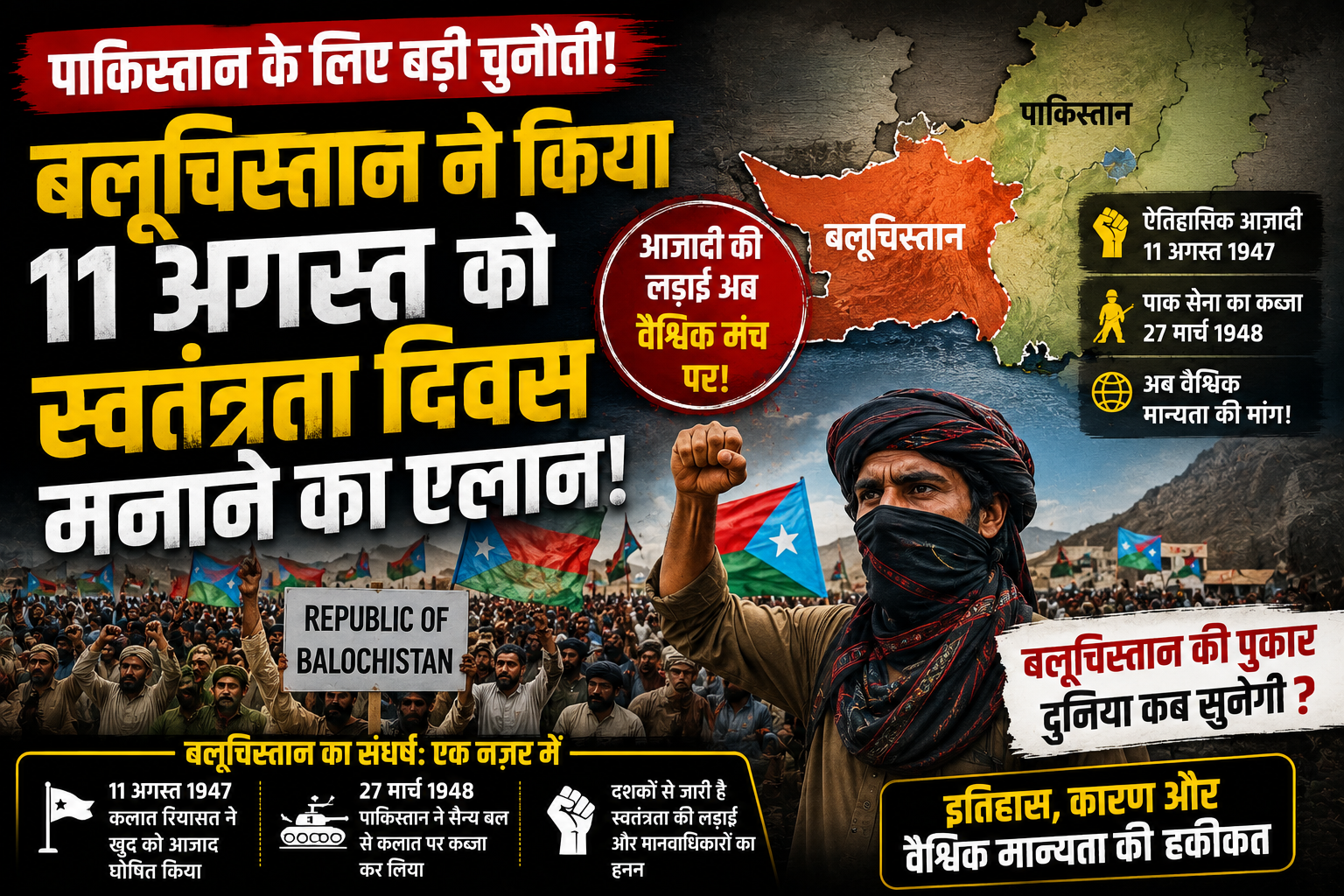
Why Did Balochistan Announce 11 August as Its Independence
Balochistan’s 11 August Independence Day Call: History, Politics, Human Rights, and the Reality of International Recognition
A renewed debate over Balochistan has emerged after Baloch nationalist groups and overseas activists announced plans to observe 11 August as Balochistan’s Independence Day and called for international recognition of an independent “Republic of Balochistan.” The announcement has attracted attention in Pakistan, India, and among international observers because it touches on a long-running conflict involving history, federal power, natural resources, human rights, and questions of self-determination.
This article explains what happened, why 11 August is symbolically important, what Baloch groups are demanding, what Pakistan says, and what international law actually allows. The focus is on verified historical facts and publicly documented developments, not on unverified claims circulating on social media.
Why Is 11 August Important for Baloch Nationalists?
The date is linked to the history of the Khanate of Kalat, a princely state that existed in present-day Balochistan during British rule.
The historical sequence
11 August 1947
Kalat announced its independence as British rule in the subcontinent was ending.
August 1947 – March 1948
Negotiations took place between Kalat and the newly created state of Pakistan.
27 March 1948
Kalat acceded to Pakistan after political negotiations and military pressure, a point that remains deeply disputed.
For Baloch nationalists, 11 August 1947 represents a brief moment of sovereignty. For the Pakistani state, the accession of Kalat in 1948 is considered a lawful part of the country’s territorial formation.
This disagreement over historical legitimacy remains one of the foundations of the modern Baloch nationalist movement.
What Was Recently Announced?
In recent weeks, several Baloch nationalist activists and organizations operating mainly from outside Pakistan have called for:
-
Observing 11 August as Independence Day
-
Expanding international awareness campaigns
-
Seeking diplomatic recognition from foreign governments
-
Raising the issue at international forums
It is important to distinguish between activist declarations and official state recognition. As of now, no country, including India, has officially recognized an independent Republic of Balochistan.
Understanding Balochistan: Pakistan’s Largest Province
Balochistan is geographically Pakistan’s largest province, covering about 44% of the country’s land area, but it has a relatively small share of the national population.


7
It is rich in:
-
Natural gas
-
Copper
-
Gold
-
Coal
-
Other minerals
Major projects such as Gwadar Port and the China-Pakistan Economic Corridor (CPEC) have increased the province’s strategic importance.
Why Is There a Baloch Insurgency?
The conflict is not new. Baloch insurgencies have occurred in different phases since Pakistan’s early years, including uprisings in:
-
1948
-
1958–59
-
1962–63
-
1973–77
-
The ongoing insurgency that intensified in the 2000s
Different Baloch groups have different goals. Some demand greater provincial autonomy and control over resources, while others seek complete independence from Pakistan.
The Human Rights Question
One of the most internationally discussed aspects of the Baloch issue is the allegation of enforced disappearances.
Organizations such as:
-
Human Rights Commission of Pakistan
-
Amnesty International
-
Human Rights Watch
have documented concerns regarding:
-
Missing persons
-
Arbitrary detention
-
Due process violations
-
Restrictions on activists and journalists
Families of missing persons have repeatedly organized marches and protests demanding information about their relatives.
The Pakistani government denies involvement in unlawful disappearances and says that many individuals are linked to militant organizations or have gone underground. The issue remains contested and politically sensitive.
Resource Control: The Economic Grievance
A central Baloch complaint is that the province’s natural wealth does not sufficiently benefit local people.
Nationalist argument
-
Gas and mineral revenues are controlled by Islamabad.
-
Local communities remain poor.
-
Development indicators lag behind national averages.
-
Employment opportunities go to outsiders.
Government argument
-
Federal funds have been invested in infrastructure.
-
Security problems discourage investment.
-
Development projects are intended to benefit the entire province.
The debate is therefore not only about resources, but about who controls them and who receives the benefits.
CPEC and the Gwadar Controversy
The China-Pakistan Economic Corridor (CPEC) has made Balochistan strategically important for both Pakistan and China.
Why nationalists oppose it
Some Baloch groups argue that:
-
Local communities were not adequately consulted.
-
Land acquisition has created resentment.
-
Demographic changes may marginalize Baloch populations.
-
Security measures around CPEC projects restrict local movement.
Why the government supports it
Pakistan describes CPEC as a transformative development initiative that will bring:
-
Roads
-
Ports
-
Energy projects
-
Jobs
-
Investment
Militant groups such as the Baloch Liberation Army (BLA) have carried out attacks targeting security forces and, in some cases, Chinese interests. Pakistan designates the BLA as a terrorist organization.
Is Balochistan “Under Control” of Nationalist Forces?
Social media posts often claim that nationalist groups control large parts of Balochistan.
These claims should be treated with caution.
The verified situation is:
-
Pakistan exercises formal state control over the province.
-
Security forces maintain administrative authority.
-
Insurgent groups operate in certain areas and are capable of carrying out attacks.
-
There is no internationally recognized parallel Baloch government exercising sovereign control over Balochistan.
Can Balochistan Become an Independent Country?
This is where international law becomes crucial.
A declaration is not enough
Many movements around the world have declared independence, but only some have achieved statehood.
For a new state to gain broad international acceptance, factors usually include:
Defined territory
Clear territorial boundaries.
Permanent population
A stable resident population.
Effective government
Actual administrative control.
International recognition
Recognition by other states.
This is often associated with the Montevideo Convention criteria in international law.
At present, Baloch nationalist groups do not possess broad international recognition, and the United Nations continues to recognize Balochistan as part of Pakistan.
What About India?
Baloch activists have frequently appealed to India for support.
India has occasionally raised concerns about human rights in Balochistan in diplomatic contexts, but India has not recognized Balochistan as an independent country.
Recognition of a secessionist movement is a major foreign-policy step with significant legal and geopolitical consequences, and no such official decision has been announced.
Pakistan’s Position
Pakistan maintains that:
-
Balochistan is an integral part of Pakistan.
-
Separatist groups are supported by hostile foreign actors.
-
Security operations are necessary to combat terrorism.
-
Development projects are intended to improve the province.
The Pakistani military and government view the insurgency primarily through a security and counterterrorism framework.
Why This Matters Globally
Balochistan is not only a domestic Pakistani issue. It matters because of:
-
CPEC
-
Gwadar Port
-
The Arabian Sea
-
Regional trade routes
-
China’s strategic interests
-
India-Pakistan tensions
-
Iran’s own Baloch population
Any major escalation could have implications beyond Pakistan.
The Difference Between Symbolism and Statehood
The recent 11 August call is significant mainly as a symbolic and political act.
It may:
-
Increase international attention
-
Mobilize the Baloch diaspora
-
Pressure Pakistan on human rights issues
-
Strengthen nationalist identity
But it does not automatically create a new country.
This distinction is essential because social media discussions often blur the line between political aspiration and legal reality.
A Balanced Assessment
What is supported by historical evidence?
-
Kalat declared independence in August 1947.
-
Kalat acceded to Pakistan in March 1948.
-
Baloch insurgencies have occurred repeatedly.
-
Human rights concerns have been documented by multiple organizations.
-
CPEC has intensified political debate in Balochistan.
What remains disputed?
-
Whether the 1948 accession was voluntary or coerced.
-
The scale of local support for independence.
-
The extent of state abuses.
-
The degree of foreign involvement.
What is currently not established?
-
International recognition of an independent Balochistan.
-
Effective sovereign control by a Baloch nationalist government.
Conclusion
The announcement to observe 11 August as Balochistan’s Independence Day reflects the persistence of Baloch nationalist aspirations and the continuing contest over history, identity, resources, and political power.
For supporters of the movement, the date symbolizes a lost sovereignty that they seek to restore. For Pakistan, it challenges the legitimacy of the country’s territorial integrity. For the international community, it raises difficult questions about self-determination, human rights, security, and regional stability.
The most important takeaway is that the current development should be understood neither as the birth of a new recognized state nor as a trivial symbolic gesture. It is part of a long-running and unresolved political conflict whose outcome remains uncertain.
As of today, Balochistan remains a province of Pakistan under international law, while the demand for independence continues to be advanced by sections of the Baloch nationalist movement through political campaigns, diaspora activism, and, in some cases, armed insurgency.
Related Articles
PM Modi Five-Nation Tour 2026: Key Deals, Energy Pacts & Strategic Outcomes
READ MORE →
PM Modi Gets Grand Cross Award in Norway | Green Strategic Partnership
READ MORE →
PoJK Unrest 2026: 13 Private Schools Deregistered, Students
READ MORE →